>
Eupercaria/misc (Various families in series Eupercaria) >
Labridae (Wrasses) > Julidinae
Etymology: Thalassoma: Greek, thalassa = the sea + Greek, soma = body; the colour of the sea (Ref. 45335).
More on authors: Lay & Bennett.
Entorno: milieu / zona climática / rango de profundidad / gama de distribución
Ecología
marino asociado a arrecife; rango de profundidad 0 - 40 m (Ref. 2334), usually 1 - 5 m (Ref. 90102). Tropical; 30°N - 32°S
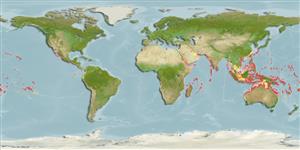
Indo-Pacific: East Africa to the Hawaiian, Marquesan, and Tuamoto islands, north to the Ryukyu Islands. Replaced by Thalassoma cupido from southern Japan to Taiwan, Thalassoma heiseri in Pitcairn, and Thalassoma loxum at Oman (Ref. 37816). Reported hybrids with Thalassoma jansenii in Banda Sea, Indonesia and with Thalassoma nigrofasciatum in Holmes Reef, Coral Sea (Ref. 57554).
Tamaño / Peso / Edad
Madurez: Lm ? range ? - ? cm
Max length : 17.0 cm TL macho / no sexado; (Ref. 4392)
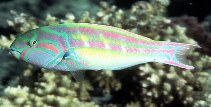
Espinas dorsales (total) : 8; Radios blandos dorsales (total) : 12 - 14; Espinas anales: 3; Radios blandos anales: 10 - 12. Males display with brilliant colors, red lines turning purple and often the abdomen bright yellow (Ref. 48636). Two uneven red stripes on dorsal half of body, 1 from below dorsal-fin origin onto upper caudal lobe, the other from above pectoral-fin base to caudal peduncle. Pectoral fins with green base and dark pectoral fins (Ref 9823).
Body shape (shape guide): fusiform / normal; Cross section: compressed.
Found in clear outer lagoon reefs (Ref. 9710) and exposed seaward reefs. Abundant in shallow exposed areas with surge channels (Ref. 9710, 48636), with gutters, large Acropora plates and algae bottom (Ref. 48636). Benthopelagic (Ref. 58302). Males are often in small loose numbers, swimming over reef sections where small groups of females stay close to the bottom. Juveniles secretive in shallow gutters (Ref. 48636). Feed mainly on benthic crustaceans (crabs, shrimps), small fishes, gastropod mollusks, and sea urchins.
Ciclo vital y comportamiento de apareamiento
Madurez | Reproducción | Puesta | Huevos | Fecundidad | Larva
Pelagic spawner.
Randall, J.E., G.R. Allen and R.C. Steene, 1990. Fishes of the Great Barrier Reef and Coral Sea. University of Hawaii Press, Honolulu, Hawaii. 506 p. (Ref. 2334)
Situación en la Lista Roja de la UICN (Ref. 130435: Version 2025-2 (Global))
Amenaza para el ser humano
Harmless
Usos humanos
Pesquerías: comercial; Acuario: Comercial
Herramientas
Informes especiales
Descargar XML
Fuentes de Internet
Estimaciones basadas en modelos
Temperatura preferida (Referencia
123201): 25 - 29.3, mean 28.3 °C (based on 2873 cells).
Índice de diversidad filogenética (Referencia
82804): PD
50 = 0.5000 [Uniqueness, from 0.5 = low to 2.0 = high].
Bayesian length-weight: a=0.01000 (0.00446 - 0.02243), b=3.05 (2.88 - 3.22), in cm total length, based on LWR estimates for this Genus-body shape (Ref.
93245).
Nivel trófico (Referencia
69278): 3.6 ±0.56 se; based on food items.
Resiliencia (Referencia
120179): Alto, población duplicada en un tiempo mínimo inferior a 15 meses (Preliminary K or Fecundity.).
Vulnerabilidad pesquera (Ref.
59153): Low vulnerability (10 of 100).
🛈
Nutrientes (Ref.
124155): Calcium = 77.5 [46.8, 130.8] mg/100g; Iron = 0.69 [0.41, 1.26] mg/100g; Protein = 18.5 [15.7, 20.7] %; Omega3 = 0.161 [0.105, 0.250] g/100g; Selenium = 25 [15, 44] μg/100g; VitaminA = 140 [44, 517] μg/100g; Zinc = 1.59 [1.10, 2.46] mg/100g (wet weight);