สิ่งแวดล้อม : สิ่งแวดล้อม / เขตภูมิอากาศ / ระดับความลึก / ระยะการกระจายสินค้า
นิเวศวิทยา
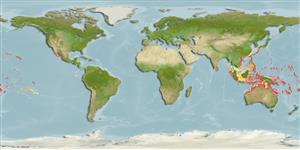
เกี่ยวกับทะเล,น้ำเค็ม เกี่ยวกับหินโสโครก; ไม่มีการอพยพย้ายถิ่น; ระดับความลึก 0 - 40 m (Ref. 7247). Tropical; 35°N - 25°S
Western Pacific: widespread, from southern Japan to Australia and Tonga; no records from Hawaii nor French Polynesia. Replaced by Chromis opercularis in the Indian Ocean (Ref. 129596).
ขนาด / น้ำหนัก / อายุ
วัยเจริญพันธุ์: Lm ? range ? - ? cm
Max length : 17.0 cm TL เพศผู้/กระเทย; (Ref. 90102)
คำอธิบายสั้นๆ
เครื่องมือที่ใช้ในการแยกชนิดสัตว์,สิ่งมีชีวิตออกจากกัน | สัณฐานวิทยา | ความยาวต่างๆ
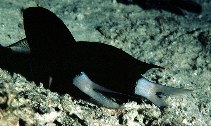
เงี่ยงครีบหลัง (รวม) : 13; ก้านครีบอ่อนที่หาง (รวม) : 10 - 11; เงี่ยงครีบก้น: 2; ก้านครีบอ่อนที่ก้น: 10 - 11. This species is distinguished by the following set of characters: D XIII,10-11(mode 11); A II,10-11 (11); pectoral-fin rays 18-20 (19); upper and lower procurrent caudal-fin rays 3; pored lateral-line scales 17-18 (18); gill rakers 6-8 (7) + 19-22 (21) = 26-30 (28); longest dorsal-fin soft ray length 24.6-36.4% (mean 29.4%) of SL; first anal-fin spine length 6.5-8.4% (7.1%) of SL; caudal-fin length 43.9-59.8% (48.6%) of SL; posterior tips of caudal-fin lobes are filamentous; broad black bands along the preopercular and opercular margins, sum width of two bands 15.3-27.9% (23.6%) of head length; distal half of soft-rayed portion of the dorsal fin is transparent in adults; upper or lower caudal-fin base no triangular black blotches; caudal peduncle and fin are tinged with yellow; soft-rayed portions of dorsal and anal fins are yellowish, with spinous portion of dorsal and pelvic fins dark blue in juveniles (Ref. 129596).
Body shape (shape guide): short and / or deep; Cross section: compressed.
Adults are found in steep outer reef slopes and shallow coastal reef flats, sometimes forming large aggregations feeding on zooplankton several meters above the bottom. Juveniles remain close to shelter. Oviparous, distinct pairing during breeding (Ref. 205). Eggs are demersal and adhere to the substrate (Ref. 205). Nests are found in small patches of loose sand under ledges or at the base of slopes (Ref. 9710). Males guard and aerate the eggs (Ref. 205). Diurnal species (Ref. 54980; 113699). Minimum depth reported taken from Ref. 128797.
วงจรชีวิตและพฤติกรรมการผสมพันธุ์
วัยเจริญพันธุ์ | การสืบพันธุ์ | การวางไข่ | เซลสืบพันธ์ของเพศเมีย(ไข่) | ความดกของไข่ | ตัวอ่อน
Oviparous, distinct pairing during breeding (Ref. 205). Eggs are demersal and adhere to the substrate (Ref. 205). Males guard and aerate the eggs (Ref. 205).
Allen, G.R., 1991. Damselfishes of the world. Mergus Publishers, Melle, Germany. 271 p. (Ref. 7247)
สถานะบัญชีแดงของ IUCN (Ref. 130435: Version 2025-2 (Global))
ภัยคุกคามต่อมนุษย์
Harmless
การใช้ของมนุษย์
การประมง: การค้า; สถานที่แสดงสัตว์และพืชน้ำ: การค้า
เครื่องมือ
รายงานพิเศษ
ดาวน์โหลด XML
แหล่งที่มาจากอินเตอร์เน็ต
การประมาณค่าตามแบบจำลอง
อุณหภูมิที่ต้องการ (อ้างอิง
123201): 24.7 - 28.9, mean 27.7 °C (based on 424 cells).
ดัชนีความหลากหลายทางวิวัฒนาการ (อ้างอิง
82804): PD
50 = 0.5000 [Uniqueness, from 0.5 = low to 2.0 = high].
Bayesian length-weight: a=0.01445 (0.00680 - 0.03071), b=2.94 (2.76 - 3.12), in cm total length, based on LWR estimates for this species & Genus-body shape (Ref.
93245).
ระดับชั้นอาหาร (อ้างอิง
69278): 3.4 ±0.45 se; based on food items.
ความสามารถในการกลับคืนสู่ปกติ (อ้างอิง
120179): ขนาดกลาง, เวลาต่ำสุดที่จะทำให้ประชากรเพิ่มขึ้นเป็น 2 เท่าใช้เวลา 1.4 - 4.4 ปี (Preliminary K or Fecundity.).
ความเสี่ยงต่อการตกปลา (Ref.
59153): Low vulnerability (10 of 100).
🛈
สารอาหาร (Ref.
124155): Calcium = 79.2 [39.4, 122.1] mg/100g; Iron = 0.721 [0.430, 1.172] mg/100g; Protein = 18.3 [17.2, 19.4] %; Omega3 = 0.116 [0.070, 0.190] g/100g; Selenium = 25.6 [13.4, 49.3] μg/100g; VitaminA = 132 [39, 433] μg/100g; Zinc = 1.25 [0.83, 1.78] mg/100g (wet weight);