>
Ovalentaria/misc (Various families in series Ovalentaria) >
Pomacentridae (Damselfishes) > Pomacentrinae
Etymology: Neopomacentrus: Greek, neos = new + Greek,poma = cover, operculum + Greek,kentron = sting (Ref. 45335).
More on author: Bleeker.
สิ่งแวดล้อม : สิ่งแวดล้อม / เขตภูมิอากาศ / ระดับความลึก / ระยะการกระจายสินค้า
นิเวศวิทยา
เกี่ยวกับทะเล,น้ำเค็ม เกี่ยวกับหินโสโครก; ไม่มีการอพยพย้ายถิ่น; ระดับความลึก 1 - 30 m (Ref. 1602). Tropical; 25°N - 21°S
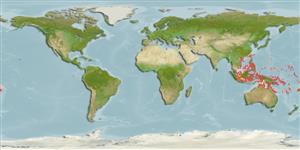
Western Central Pacific: Indonesia to Solomon Islands, north to Japan, south to northern Australia and Vanuatu.
ขนาด / น้ำหนัก / อายุ
วัยเจริญพันธุ์: Lm ? range ? - ? cm
Max length : 7.5 cm TL เพศผู้/กระเทย; (Ref. 48636)
คำอธิบายสั้นๆ
เครื่องมือที่ใช้ในการแยกชนิดสัตว์,สิ่งมีชีวิตออกจากกัน | สัณฐานวิทยา | ความยาวต่างๆ
เงี่ยงครีบหลัง (รวม) : 13; ก้านครีบอ่อนที่หาง (รวม) : 11 - 12; เงี่ยงครีบก้น: 2; ก้านครีบอ่อนที่ก้น: 10 - 11.
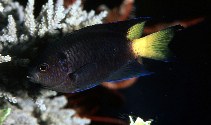
Body shape (shape guide): fusiform / normal; Cross section: oval.
Adults are found in lagoons, harbors, and coastal reefs, shallow habitats, deep sand or mud slopes with outcrops of debris or coral rubble pieces, or on rocky substrates in sheltered bays. They usually occur in large aggregations, sometimes forming mixed aggregations with Neopomacentrus sp. Abundant around sponge-encrusted mooring buoys and their anchor lines and occur in smaller colonies around rocks and refuse (Ref. 1602). Oviparous, distinct pairing during breeding (Ref. 205). Eggs are demersal and adhere to the substrate (Ref. 205). Males guard and aerate the eggs (Ref. 205). Diurnal species (Ref. 113699).
วงจรชีวิตและพฤติกรรมการผสมพันธุ์
วัยเจริญพันธุ์ | การสืบพันธุ์ | การวางไข่ | เซลสืบพันธ์ของเพศเมีย(ไข่) | ความดกของไข่ | ตัวอ่อน
Oviparous, distinct pairing during breeding (Ref. 205). Eggs are demersal and adhere to the substrate (Ref. 205). Males guard and aerate the eggs (Ref. 205).
Allen, G.R., 1991. Damselfishes of the world. Mergus Publishers, Melle, Germany. 271 p. (Ref. 7247)
สถานะบัญชีแดงของ IUCN (Ref. 130435: Version 2025-2 (Global))
ภัยคุกคามต่อมนุษย์
Harmless
การใช้ของมนุษย์
เครื่องมือ
รายงานพิเศษ
ดาวน์โหลด XML
แหล่งที่มาจากอินเตอร์เน็ต
การประมาณค่าตามแบบจำลอง
อุณหภูมิที่ต้องการ (อ้างอิง
123201): 26.1 - 29.3, mean 28.7 °C (based on 1965 cells).
ดัชนีความหลากหลายทางวิวัฒนาการ (อ้างอิง
82804): PD
50 = 0.5000 [Uniqueness, from 0.5 = low to 2.0 = high].
Bayesian length-weight: a=0.01479 (0.00681 - 0.03215), b=3.00 (2.81 - 3.19), in cm total length, based on LWR estimates for this species & (Sub)family-body (Ref.
93245).
ระดับชั้นอาหาร (อ้างอิง
69278): 3.4 ±0.45 se; based on food items.
ความสามารถในการกลับคืนสู่ปกติ (อ้างอิง
120179): ความสูง, เวลาต่ำสุดที่จะทำให้ประชากรเพิ่มขึ้นเป็น 2 เท่าใช้เวลาน้อยกว่า 15 เดือน (Preliminary K or Fecundity.).
ความเสี่ยงต่อการตกปลา (Ref.
59153): Low vulnerability (10 of 100).
🛈
สารอาหาร (Ref.
124155): Calcium = 142 [84, 273] mg/100g; Iron = 1.02 [0.63, 1.66] mg/100g; Protein = 18.6 [17.6, 19.6] %; Omega3 = 0.169 [0.098, 0.289] g/100g; Selenium = 21.1 [11.4, 41.2] μg/100g; VitaminA = 245 [87, 671] μg/100g; Zinc = 1.94 [1.32, 2.75] mg/100g (wet weight);