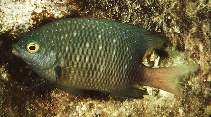
>
Ovalentaria/misc (Various families in series Ovalentaria) >
Pomacentridae (Damselfishes) > Microspathodontinae
Etymology: Stegastes: Greek, stegastos, -e, -on = covered (Ref. 45335).
Eponymy: The authors gave no etymological explanation, but the meaning of lacrymatus is ‘with tears’ and perhaps the allusion is explained as the authors dedicated this species to the “…memory of Mr. [...] (Ref. 128868), visit book page.
More on authors: Quoy & Gaimard.
Milieu: milieu / Klimaatzone / Diepte / verspreidingsgebied
Ecologie
marien rifbewoner; standvastig; diepte 0 - 40 m (Ref. 1602). Tropical; 32°N - 36°S, 24°E - 137°W
Indo-Pacific: Red Sea and East Africa to the Marshall and Society islands, north to the Ryukyu Islands, south to Australia.
Grootte / Gewicht / Leeftijd
Maturiteit: Lm ? range ? - ? cm
Max length : 10.0 cm TL mannelijk / geslacht onbekend; (Ref. 4391)
Korte beschrijving
Determinatiesleutels | Morfologie | Morfometrie
Dorsale stekels (totaal) : 12; Dorsale zachte stralen (totaal) : 16 - 18; Anale stekels: 2; Anale zachte stralen: 13 - 14.
Body shape (shape guide): short and / or deep; Cross section: compressed.
Adults inhabit clear lagoon and seaward reefs, in areas with mixed coral and rubble or dead coral rocks. Feed mainly on benthic algae and associated small invertebrates and fish eggs (Ref. 7247). Oviparous, distinct pairing during breeding (Ref. 205). Eggs are demersal and adhere to the substrate (Ref. 205). Males guard and aerate the eggs (Ref. 205). Diurnal species (Ref. 113699, 12037). Minimum depth reported taken from Ref. 128797.
Levenscyclus en paargedrag
Maturiteit | Voortplanting | Paaien | Eieren | Fecunditeit | Larven
Oviparous, distinct pairing during breeding (Ref. 205). Eggs are demersal and adhere to the substrate (Ref. 205). Males guard and aerate the eggs (Ref. 205).
Allen, G.R., 1991. Damselfishes of the world. Mergus Publishers, Melle, Germany. 271 p. (Ref. 7247)
Status op de Rode Lijst van het IUCN (Ref. 130435: Version 2025-2 (Global))
Gevaar voor de mens
Harmless
Gebruik door de mens
Visserij: van geen belang; Aquarium: Commercieel
Tools
Speciale rapporten
Download XML
Internetbronnen
Schattingen op basis van modellen
Gewenste temperatuur (Ref.
123201): 24.7 - 28.9, mean 27.6 °C (based on 590 cells).
Fylogenetische diversiteitsindex (Ref.
82804): PD
50 = 0.5000 [Uniqueness, from 0.5 = low to 2.0 = high].
Bayesian length-weight: a=0.02089 (0.00936 - 0.04665), b=2.98 (2.80 - 3.16), in cm total length, based on LWR estimates for this Genus-body shape (Ref.
93245).
Trofisch niveau (Ref.
69278): 2.2 ±0.2 se; based on diet studies.
Weerstandsvermogen (Ref.
120179): Hoog, minimale populatieverdubbelingstijd minder dan 15 maanden (Preliminary K or Fecundity.).
Kwetsbaarheid van de visserij (Ref.
59153): Low vulnerability (10 of 100).
🛈
Voedingsstoffen (Ref.
124155): Calcium = 124 [60, 194] mg/100g; Iron = 0.821 [0.501, 1.381] mg/100g; Protein = 18 [17, 19] %; Omega3 = 0.114 [0.067, 0.188] g/100g; Selenium = 26.8 [14.1, 53.1] μg/100g; VitaminA = 79 [19, 300] μg/100g; Zinc = 1.99 [1.34, 2.96] mg/100g (wet weight);