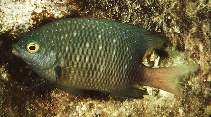
>
Ovalentaria/misc (Various families in series Ovalentaria) >
Pomacentridae (Damselfishes) > Microspathodontinae
Etymology: Stegastes: Greek, stegastos, -e, -on = covered (Ref. 45335).
Eponymy: The authors gave no etymological explanation, but the meaning of lacrymatus is ‘with tears’ and perhaps the allusion is explained as the authors dedicated this species to the “…memory of Mr. [...] (Ref. 128868), visit book page.
More on authors: Quoy & Gaimard.
Environnement : milieu / zone climatique / profondeur / gamme de distribution
Écologie
marin récifal; non migrateur; profondeur 0 - 40 m (Ref. 1602). Tropical; 32°N - 36°S, 24°E - 137°W
Indo-Pacific: Red Sea and East Africa to the Marshall and Society islands, north to the Ryukyu Islands, south to Australia.
Taille / Poids / Âge
Maturité: Lm ? range ? - ? cm
Max length : 10.0 cm TL mâle / non sexé; (Ref. 4391)
Description synthétique
Clés d'identification | Morphologie | Morphométrie
Épines dorsales (Total) : 12; Rayons mous dorsaux (Total) : 16 - 18; Épines anales: 2; Rayons mous anaux: 13 - 14.
Body shape (shape guide): short and / or deep; Cross section: compressed.
Adults inhabit clear lagoon and seaward reefs, in areas with mixed coral and rubble or dead coral rocks. Feed mainly on benthic algae and associated small invertebrates and fish eggs (Ref. 7247). Oviparous, distinct pairing during breeding (Ref. 205). Eggs are demersal and adhere to the substrate (Ref. 205). Males guard and aerate the eggs (Ref. 205). Diurnal species (Ref. 113699, 12037). Minimum depth reported taken from Ref. 128797.
Cycle de vie et comportement reproducteur
Maturité | Reproduction | Frai | Œufs | Fécondité | Larves
Oviparous, distinct pairing during breeding (Ref. 205). Eggs are demersal and adhere to the substrate (Ref. 205). Males guard and aerate the eggs (Ref. 205).
Allen, G.R., 1991. Damselfishes of the world. Mergus Publishers, Melle, Germany. 271 p. (Ref. 7247)
Statut dans la liste rouge de l'IUCN (Ref. 130435: Version 2025-2 (Global))
Menace pour l'homme
Harmless
Utilisations par l'homme
Pêcheries: sans intérêt; Aquarium: Commercial
Outils
Articles particuliers
Télécharger en XML
Sources Internet
Estimations basées sur des modèles
Température préférée (Réf.
123201): 24.7 - 28.9, mean 27.6 °C (based on 590 cells).
Indice de diversité phylogénétique (Réf.
82804): PD
50 = 0.5000 [Uniqueness, from 0.5 = low to 2.0 = high].
Bayesian length-weight: a=0.02089 (0.00936 - 0.04665), b=2.98 (2.80 - 3.16), in cm total length, based on LWR estimates for this Genus-body shape (Ref.
93245).
Niveau trophique (Réf.
69278): 2.2 ±0.2 se; based on diet studies.
Résilience (Réf.
120179): Haut, temps minimum de doublement de population inférieur à 15 mois (Preliminary K or Fecundity.).
Vulnérabilité de la pêche (Ref.
59153): Low vulnerability (10 of 100).
🛈
Nutriments (Ref.
124155): Calcium = 124 [60, 194] mg/100g; Iron = 0.821 [0.501, 1.381] mg/100g; Protein = 18 [17, 19] %; Omega3 = 0.114 [0.067, 0.188] g/100g; Selenium = 26.8 [14.1, 53.1] μg/100g; VitaminA = 79 [19, 300] μg/100g; Zinc = 1.99 [1.34, 2.96] mg/100g (wet weight);