>
Tetraodontiformes (Puffers and filefishes) >
Monacanthidae (Filefishes)
Etymology: Paramonacanthus: Greek, para = the side of + Greek, monos = one + Greek, akantha ) thorn (Ref. 45335).
Umwelt: Milieu / Klimazone / Tiefenbereich / Verbreitungsgebiet
Ökologie
seewasser demersal; tiefenbereich 10 - 50 m (Ref. 90102). Tropical
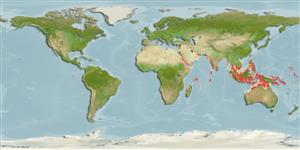
Indian Ocean: both sides of India, and across to the western coast of Thailand. A small post-pelagic juvenile has been collected from the Maldives.
Größe / Gewicht / Alter
Geschlechtsreife: Lm ? range ? - ? cm
Max length : 10.0 cm SL Männchen/unbestimmt; (Ref. 48637)
Kurzbeschreibung
Bestimmungsschlüssel | Morphologie | Morphometrie
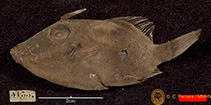
Rückenflossenstacheln (insgesamt) : 2; Rückenflossenweichstrahlen (insgesamt) : 26 - 29; Afterflossenstacheln: 0; Afterflossenweichstrahlen: 27 - 30; Wirbelzahl: 19. Body width 1.9-2.5 in head length; body depth 2.0-2.8 in SL; head length 2.6-3.0 in SL; snout length 3.7-4.3 in SL; eye diameter 2.7-3.8 in head length. Head and body pale, with three wide, darker but rather indistinct stripes on body, first from eye to anterior half of soft dorsal base, second from above gill opening, continuing posteriorly to rear half of soft dorsal base, and third curving up from ventral flap, extending along midside of body to caudal peduncle; two prominent dark blotches separated by a pale wedge-shaped bar below anterior portion of soft dorsal fin; caudal fin with dusky basal blotch, followed by two dark curved cross bands.
Body shape (shape guide): short and / or deep; Cross section: compressed.
Inhabits muddy substrates in estuaries and usually found near algae rubble reef (Ref. 48637). Also found in sand bottoms of trawling grounds in 10-50 m (Ref. 90102).
Lebenszyklus und Paarungsverhalten
Geschlechtsreife | Fortpflanzung | Ablaichen | Eier | Fruchtbarkeit | Larven
Hutchins, J.B., 1997. Review of the monacanthid fish genus Paramonacanthus, with descriptions of three new species. Rec. West. Aust. Mus. Suppl. No. 54:1-57. (Ref. 33065)
IUCN Rote Liste Status (Ref. 130435: Version 2025-2 (Global))
Bedrohung für Menschen
Harmless
Nutzung durch Menschen
Tools
Zusatzinformationen
Download XML
Internet Quellen
Schätzungen auf der Grundlage von Modellen
Bevorzugte Temperatur (Ref.
123201): 27.5 - 29.2, mean 28.6 °C (based on 576 cells).
Phylogenetischer Diversitätsindex (Ref.
82804): PD
50 = 0.5000 [Uniqueness, from 0.5 = low to 2.0 = high].
Bayesian length-weight: a=0.01905 (0.00905 - 0.04012), b=2.93 (2.75 - 3.11), in cm total length, based on LWR estimates for this (Sub)family-body shape (Ref.
93245).
Trophische Ebene (Ref.
69278): 3.1 ±0.3 se; based on size and trophs of closest relatives
Widerstandsfähigkeit (Ref.
120179): hoch, Verdopplung der Population dauert weniger als 15 Monate. (Preliminary K or Fecundity.).
Anfälligkeit der Fischerei (Ref.
59153): Low vulnerability (10 of 100).
🛈