>
Tetraodontiformes (Puffers and filefishes) >
Monacanthidae (Filefishes)
Etymology: Paramonacanthus: Greek, para = the side of + Greek, monos = one + Greek, akantha ) thorn (Ref. 45335).
Entorno: milieu / zona climática / rango de profundidad / gama de distribución
Ecología
marino demersal; rango de profundidad 10 - 50 m (Ref. 90102). Tropical
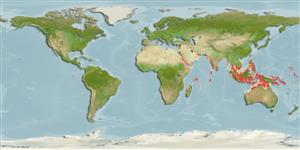
Indian Ocean: both sides of India, and across to the western coast of Thailand. A small post-pelagic juvenile has been collected from the Maldives.
Tamaño / Peso / Edad
Madurez: Lm ? range ? - ? cm
Max length : 10.0 cm SL macho / no sexado; (Ref. 48637)
Descripción breve
Claves de identificación | Morfología | Morfometría
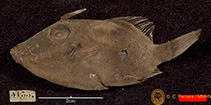
Espinas dorsales (total) : 2; Radios blandos dorsales (total) : 26 - 29; Espinas anales: 0; Radios blandos anales: 27 - 30; Vértebra: 19. Body width 1.9-2.5 in head length; body depth 2.0-2.8 in SL; head length 2.6-3.0 in SL; snout length 3.7-4.3 in SL; eye diameter 2.7-3.8 in head length. Head and body pale, with three wide, darker but rather indistinct stripes on body, first from eye to anterior half of soft dorsal base, second from above gill opening, continuing posteriorly to rear half of soft dorsal base, and third curving up from ventral flap, extending along midside of body to caudal peduncle; two prominent dark blotches separated by a pale wedge-shaped bar below anterior portion of soft dorsal fin; caudal fin with dusky basal blotch, followed by two dark curved cross bands.
Body shape (shape guide): short and / or deep; Cross section: compressed.
Inhabits muddy substrates in estuaries and usually found near algae rubble reef (Ref. 48637). Also found in sand bottoms of trawling grounds in 10-50 m (Ref. 90102).
Ciclo vital y comportamiento de apareamiento
Madurez | Reproducción | Puesta | Huevos | Fecundidad | Larva
Hutchins, J.B., 1997. Review of the monacanthid fish genus Paramonacanthus, with descriptions of three new species. Rec. West. Aust. Mus. Suppl. No. 54:1-57. (Ref. 33065)
Situación en la Lista Roja de la UICN (Ref. 130435: Version 2025-2 (Global))
Amenaza para el ser humano
Harmless
Usos humanos
Herramientas
Informes especiales
Descargar XML
Fuentes de Internet
Estimaciones basadas en modelos
Temperatura preferida (Referencia
123201): 27.5 - 29.2, mean 28.6 °C (based on 576 cells).
Índice de diversidad filogenética (Referencia
82804): PD
50 = 0.5000 [Uniqueness, from 0.5 = low to 2.0 = high].
Bayesian length-weight: a=0.01905 (0.00905 - 0.04012), b=2.93 (2.75 - 3.11), in cm total length, based on LWR estimates for this (Sub)family-body shape (Ref.
93245).
Nivel trófico (Referencia
69278): 3.1 ±0.3 se; based on size and trophs of closest relatives
Resiliencia (Referencia
120179): Alto, población duplicada en un tiempo mínimo inferior a 15 meses (Preliminary K or Fecundity.).
Vulnerabilidad pesquera (Ref.
59153): Low vulnerability (10 of 100).
🛈