Ελασμοβράγχιοι (καρχαρίες και σαλάχια) (sharks and rays) >
Orectolobiformes (Carpet sharks) >
Brachaeluridae (Blind sharks)
Etymology: Brachaelurus: brachys (Gr.), short, referring to short and stout body; aelurus, from ailouros (Gr.), cat, i.e., a short catshark (See ETYFish); waddi: Name given on a painting (now lost) by British ornithologist John Latham (1740-1837), from which it was described; meaning unknown, possibly based on waddi or waddy, an Australian aboriginal name for a war club and a species of tree (Acacia peuce) endemic to central Australia (See ETYFish).
Eponymy: The original description does not explain the binomial. [...] (Ref. 128868), visit book page.
More on authors: Bloch & Schneider.
Περιβάλλον: περιβάλλον / κλιματική ζώνη / εύρος βάθους / εύρος διανομής
Οικολογία
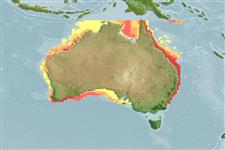
Θαλασσινό(ά) Υφαλόφιλο(α); εύρος βάθους 0 - 140 m (Ref. 6871). Tropical; 11°S - 36°S, 112°E - 143°E (Ref. 54288)
Southwest Pacific: confined to Australia, southern Queensland and New South Wales. Records from Western Australia and northern Territory need confirmation.
Μέγεθος / Βάρος / Ηλικία
Γεννητική Ωρίμανση: Lm ? range ? - ? cm
Max length : 122 cm TL αρσενικό/απροσδιόριστο; (Ref. 247); common length : 62.0 cm TL αρσενικό/απροσδιόριστο; (Ref. 247); common length :66 cm TL (female)
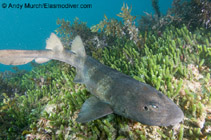
Ραχιαίες άκανθες (συνολικά) : 0; Εδρικές άκανθες: 0. Mostly with white spots on body (Ref. 13576). Caudal fin with its upper lobe at a low angle above body axis, with a strong terminal lobe and subterminal notch but no ventral lobe (Ref. 13576).
Body shape (shape guide): elongated.
Usually found close inshore in tide pools (barely deep enough to keep it covered) and at the surf line, but sometimes deeper (Ref. 247). Prefers rocky shoreline areas and coral reefs (Ref. 247, 43278). Feeds on small reef invertebrates (Ref. 247), including crabs, shrimps, cuttlefish, squid and sea anemones (Ref. 43278), and small fishes (Ref. 247). Ovoviviparous (Ref. 43278, 50449). Thrives in an aquaria and capable of living out of water for a long time (Ref. 247).
Κύκλος ζωής και συμπεριφορά ζευγαρώματος
Γεννητική Ωρίμανση | Αναπαραγωγή | Γεννοβολία | Αβγά | Γονιμότητα | Προνύμφες
Ovoviviparous, embryos feed solely on yolk (Ref. 50449). With 7 or 8 young in a litter (Ref. 247). Distinct pairing with embrace (Ref. 205).
Compagno, L.J.V., 1984. FAO Species Catalogue. Vol. 4. Sharks of the world. An annotated and illustrated catalogue of shark species known to date. Part 1 - Hexanchiformes to Lamniformes. FAO Fish. Synop. 125(4/1):1-249. Rome, FAO. (Ref. 247)
Κατάσταση Κόκκινου Καταλόγου IUCN (Ref. 130435: Version 2025-2 (Global))
Ανθρώπινες χρήσεις
αλιεία: bycatch; αλιεία αναψυχής: ναί
Εργαλεία
Ειδικές εκθέσεις
Λήψη XML
Διαδικτυακές πηγές
Εκτιμήσεις βάσει μοντέλων
Προτιμώμενη θερμοκρασία (Αναφ.
123201): 19.3 - 26.1, mean 24.2 °C (based on 140 cells).
Δείκτης φυλογενετικής ποικιλότητας (Αναφ.
82804): PD
50 = 1.0000 [Uniqueness, from 0.5 = low to 2.0 = high].
Bayesian length-weight: a=0.00389 (0.00180 - 0.00842), b=3.12 (2.94 - 3.30), in cm total length, based on all LWR estimates for this body shape (Ref.
93245).
Τροφικό Επίπεδο (Αναφ.
69278): 3.9 ±0.62 se; based on food items.
Ελαστικότητα (Αναφ.
120179): Πολύ χαμηλό, ελάχιστος χρόνος για διπλασιασμό πληθυσμού > 14 έτη (Fec=7).
Ευπάθεια στην αλιεία (Ref.
59153): High to very high vulnerability (73 of 100).
🛈
Θρεπτικά συστατικά (Ref.
124155): Calcium = 11.8 [2.5, 44.6] mg/100g; Iron = 0.368 [0.089, 1.012] mg/100g; Protein = 19.5 [17.3, 21.5] %; Omega3 = 0.0912 [, ] g/100g; Selenium = 38.2 [11.8, 102.1] μg/100g; VitaminA = 42.8 [16.4, 113.8] μg/100g; Zinc = 0.772 [0.380, 1.593] mg/100g (wet weight);