Elasmobranquios (tiburones y rayas) (sharks and rays) >
Orectolobiformes (Carpet sharks) >
Brachaeluridae (Blind sharks)
Etymology: Brachaelurus: brachys (Gr.), short, referring to short and stout body; aelurus, from ailouros (Gr.), cat, i.e., a short catshark (See ETYFish); waddi: Name given on a painting (now lost) by British ornithologist John Latham (1740-1837), from which it was described; meaning unknown, possibly based on waddi or waddy, an Australian aboriginal name for a war club and a species of tree (Acacia peuce) endemic to central Australia (See ETYFish).
Eponymy: The original description does not explain the binomial. [...] (Ref. 128868), visit book page.
More on authors: Bloch & Schneider.
Entorno: milieu / zona climática / rango de profundidad / gama de distribución
Ecología
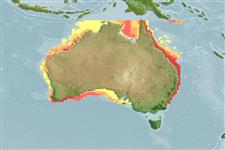
marino asociado a arrecife; rango de profundidad 0 - 140 m (Ref. 6871). Tropical; 11°S - 36°S, 112°E - 143°E (Ref. 54288)
Southwest Pacific: confined to Australia, southern Queensland and New South Wales. Records from Western Australia and northern Territory need confirmation.
Tamaño / Peso / Edad
Madurez: Lm ? range ? - ? cm
Max length : 122 cm TL macho / no sexado; (Ref. 247); common length : 62.0 cm TL macho / no sexado; (Ref. 247); common length :66 cm TL (female)
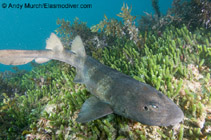
Espinas dorsales (total) : 0; Espinas anales: 0. Mostly with white spots on body (Ref. 13576). Caudal fin with its upper lobe at a low angle above body axis, with a strong terminal lobe and subterminal notch but no ventral lobe (Ref. 13576).
Body shape (shape guide): elongated.
Usually found close inshore in tide pools (barely deep enough to keep it covered) and at the surf line, but sometimes deeper (Ref. 247). Prefers rocky shoreline areas and coral reefs (Ref. 247, 43278). Feeds on small reef invertebrates (Ref. 247), including crabs, shrimps, cuttlefish, squid and sea anemones (Ref. 43278), and small fishes (Ref. 247). Ovoviviparous (Ref. 43278, 50449). Thrives in an aquaria and capable of living out of water for a long time (Ref. 247).
Ciclo vital y comportamiento de apareamiento
Madurez | Reproducción | Puesta | Huevos | Fecundidad | Larva
Ovoviviparous, embryos feed solely on yolk (Ref. 50449). With 7 or 8 young in a litter (Ref. 247). Distinct pairing with embrace (Ref. 205).
Compagno, L.J.V., 1984. FAO Species Catalogue. Vol. 4. Sharks of the world. An annotated and illustrated catalogue of shark species known to date. Part 1 - Hexanchiformes to Lamniformes. FAO Fish. Synop. 125(4/1):1-249. Rome, FAO. (Ref. 247)
Situación en la Lista Roja de la UICN (Ref. 130435: Version 2025-2 (Global))
Amenaza para el ser humano
Usos humanos
Pesquerías: bycatch; pesca deportiva: si
Herramientas
Informes especiales
Descargar XML
Fuentes de Internet
Estimaciones basadas en modelos
Temperatura preferida (Referencia
123201): 19.3 - 26.1, mean 24.2 °C (based on 140 cells).
Índice de diversidad filogenética (Referencia
82804): PD
50 = 1.0000 [Uniqueness, from 0.5 = low to 2.0 = high].
Bayesian length-weight: a=0.00389 (0.00180 - 0.00842), b=3.12 (2.94 - 3.30), in cm total length, based on all LWR estimates for this body shape (Ref.
93245).
Nivel trófico (Referencia
69278): 3.9 ±0.62 se; based on food items.
Resiliencia (Referencia
120179): Muy bajo, población duplicada en un tiempo mínimo superior a 14 años (Fec=7).
Vulnerabilidad pesquera (Ref.
59153): High to very high vulnerability (73 of 100).
🛈
Nutrientes (Ref.
124155): Calcium = 11.8 [2.5, 44.6] mg/100g; Iron = 0.368 [0.089, 1.012] mg/100g; Protein = 19.5 [17.3, 21.5] %; Omega3 = 0.0912 [, ] g/100g; Selenium = 38.2 [11.8, 102.1] μg/100g; VitaminA = 42.8 [16.4, 113.8] μg/100g; Zinc = 0.772 [0.380, 1.593] mg/100g (wet weight);