>
Eupercaria/misc (Various families in series Eupercaria) >
Labridae (Wrasses) > Labrinae
Etymology: Symphodus: Greek, syn, symphysis = grown together + Greek, odous = teeth (Ref. 45335).
More on author: Linnaeus.
Ambiente: milieu / zona climática / intervalo de profundidade / gama de distribuição
Ecologia
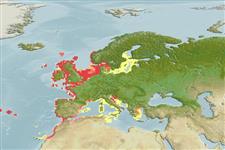
marinhas associadas(os) a recifes; não migratória, usually 1 - 30 m (Ref. 35388). Temperate; 63°N - 28°N, 32°W - 25°E
Eastern Atlantic: Norway to Morocco and the Azores. Also known from the western Mediterranean and Adriatic seas.
Comprimento na primeira maturidade / Tamanho / Peso / Idade
Maturidade: Lm 8.5, range 7 - 10 cm
Max length : 28.0 cm SL macho/indeterminado; (Ref. 4742); common length : 20.0 cm SL macho/indeterminado; (Ref. 4742); Idade máx. registada: 9 anos (Ref. 4742)
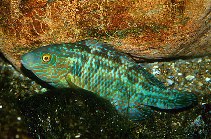
Espinhos dorsais (total) : 14 - 17; Raios dorsais moles (total) : 8 - 10; Espinhos anais: 3; Raios anais moles: 8 - 11. A few cephalic pores (7-12) on snout. Lips with 5-7 folds. Scales on temporo-occipital surface 3-5 rows; on inter-operculum 2-3 (6-13) scales; on cheek 4-7; behind eye 1. A small dark spot on caudal peduncle. Often 5 large brown blotches near dorsal fin. Females and young: with numerous spots on body more or less longitudinally lined, some sinuous lines on head (Ref. 231). Coloration very variable; ground color of the male is greenish or blue while females are brownish to yellowish (Ref. 35388).
Body shape (shape guide): fusiform / normal.
This schooling, territorial fish occurs in the littoral zone, near rocks and eel-grass beds, also in lagoons. In summer ripe females show short ovipositor. Seaweed nest built by male among rocks or in crevices. Sex reversal sometimes observed. Feed on mollusks, hydroids, bryozoans, worms and various crustaceans (Ref. 4742). Males grow faster than females (Ref. 4742). Oviparous, distinct pairing during breeding (Ref. 205).
Sex reversal sometimes observed. Seaweed nest built by male among rocks or in crevices (Ref. 4742). Oviparous, distinct pairing during breeding (Ref. 205).
Quignard, J.-P. and A. Pras, 1986. Labridae. p. 919-942. In P.J.P. Whitehead, M.-L. Bauchot, J.-C. Hureau, J. Nielsen and E. Tortonese (eds.) Fishes of the north-eastern Atlantic and the Mediterranean. UNESCO, Paris. Vol. 2. (Ref. 4742)
Categoria na Lista Vermelha da IUCN (Ref. 130435: Version 2025-2 (Global))
Ameaça para o homem
Harmless
Utilização humana
Pescarias: pescarias de subsistência; peixe desportivo: sim; Aquário: Aquários públicos
Ferramentas
Relatórios especiais
Descarregue XML
Fontes da internet
Estimativas baseadas em modelos
Temperatura preferida (Ref.
123201): 8.8 - 17.2, mean 10.5 °C (based on 514 cells).
Índice de diversidade filogenética (Ref.
82804): PD
50 = 0.5005 [Uniqueness, from 0.5 = low to 2.0 = high].
Bayesian length-weight: a=0.00871 (0.00571 - 0.01329), b=3.10 (2.98 - 3.22), in cm total length, based on LWR estimates for this species & Genus-body shape (Ref.
93245).
Nível Trófico (Ref.
69278): 3.4 ±0.1 se; based on diet studies.
Resiliência (Ref.
120179): Médio, tempo mínimo de duplicação da população 1,4 - 4,4 anos (K=0.21-0.41; tm=2-3; tmax=9).
Vulnerabilidade da pesca (Ref.
59153): Low to moderate vulnerability (34 of 100).
🛈
Vulnerabilidade climática (Ref.
125649): Moderate vulnerability (44 of 100).
🛈
Nutrientes (Ref.
124155): Calcium = 19.5 [8.0, 34.5] mg/100g; Iron = 0.208 [0.114, 0.446] mg/100g; Protein = 18.8 [15.8, 21.0] %; Omega3 = 0.366 [0.197, 0.695] g/100g; Selenium = 6.08 [2.79, 13.51] μg/100g; VitaminA = 78.2 [19.8, 379.4] μg/100g; Zinc = 0.715 [0.465, 1.300] mg/100g (wet weight);