>
Eupercaria/misc (Various families in series Eupercaria) >
Labridae (Wrasses) > Labrinae
Etymology: Symphodus: Greek, syn, symphysis = grown together + Greek, odous = teeth (Ref. 45335).
More on author: Linnaeus.
Entorno: milieu / zona climática / rango de profundidad / gama de distribución
Ecología
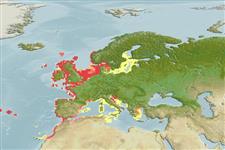
marino asociado a arrecife; no migratorio, usually 1 - 30 m (Ref. 35388). Temperate; 63°N - 28°N, 32°W - 25°E
Eastern Atlantic: Norway to Morocco and the Azores. Also known from the western Mediterranean and Adriatic seas.
Longitud en la primera madurez / Tamaño / Peso / Edad
Madurez: Lm 8.5, range 7 - 10 cm
Max length : 28.0 cm SL macho / no sexado; (Ref. 4742); common length : 20.0 cm SL macho / no sexado; (Ref. 4742); edad máxima reportada: 9 años (Ref. 4742)
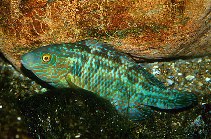
Espinas dorsales (total) : 14 - 17; Radios blandos dorsales (total) : 8 - 10; Espinas anales: 3; Radios blandos anales: 8 - 11. A few cephalic pores (7-12) on snout. Lips with 5-7 folds. Scales on temporo-occipital surface 3-5 rows; on inter-operculum 2-3 (6-13) scales; on cheek 4-7; behind eye 1. A small dark spot on caudal peduncle. Often 5 large brown blotches near dorsal fin. Females and young: with numerous spots on body more or less longitudinally lined, some sinuous lines on head (Ref. 231). Coloration very variable; ground color of the male is greenish or blue while females are brownish to yellowish (Ref. 35388).
Body shape (shape guide): fusiform / normal.
This schooling, territorial fish occurs in the littoral zone, near rocks and eel-grass beds, also in lagoons. In summer ripe females show short ovipositor. Seaweed nest built by male among rocks or in crevices. Sex reversal sometimes observed. Feed on mollusks, hydroids, bryozoans, worms and various crustaceans (Ref. 4742). Males grow faster than females (Ref. 4742). Oviparous, distinct pairing during breeding (Ref. 205).
Sex reversal sometimes observed. Seaweed nest built by male among rocks or in crevices (Ref. 4742). Oviparous, distinct pairing during breeding (Ref. 205).
Quignard, J.-P. and A. Pras, 1986. Labridae. p. 919-942. In P.J.P. Whitehead, M.-L. Bauchot, J.-C. Hureau, J. Nielsen and E. Tortonese (eds.) Fishes of the north-eastern Atlantic and the Mediterranean. UNESCO, Paris. Vol. 2. (Ref. 4742)
Situación en la Lista Roja de la UICN (Ref. 130435: Version 2025-2 (Global))
Amenaza para el ser humano
Harmless
Usos humanos
Pesquerías: pesquerías de subsistencia; pesca deportiva: si; Acuario: Acuarios públicos
Herramientas
Informes especiales
Descargar XML
Fuentes de Internet
Estimaciones basadas en modelos
Temperatura preferida (Referencia
123201): 8.8 - 17.2, mean 10.5 °C (based on 514 cells).
Índice de diversidad filogenética (Referencia
82804): PD
50 = 0.5005 [Uniqueness, from 0.5 = low to 2.0 = high].
Bayesian length-weight: a=0.00871 (0.00571 - 0.01329), b=3.10 (2.98 - 3.22), in cm total length, based on LWR estimates for this species & Genus-body shape (Ref.
93245).
Nivel trófico (Referencia
69278): 3.4 ±0.1 se; based on diet studies.
Resiliencia (Referencia
120179): Medio, población duplicada en un tiempo mínimo de 1.4-4.4 años (K=0.21-0.41; tm=2-3; tmax=9).
Vulnerabilidad pesquera (Ref.
59153): Low to moderate vulnerability (34 of 100).
🛈
Vulnerabilidad climática (Ref.
125649): Moderate vulnerability (44 of 100).
🛈
Nutrientes (Ref.
124155): Calcium = 19.5 [8.0, 34.5] mg/100g; Iron = 0.208 [0.114, 0.446] mg/100g; Protein = 18.8 [15.8, 21.0] %; Omega3 = 0.366 [0.197, 0.695] g/100g; Selenium = 6.08 [2.79, 13.51] μg/100g; VitaminA = 78.2 [19.8, 379.4] μg/100g; Zinc = 0.715 [0.465, 1.300] mg/100g (wet weight);