Élasmobranches (requins et raies) (sharks and rays) >
Carcharhiniformes (Ground sharks) >
Proscylliidae (Finback catsharks)
Etymology: Eridacnis: Etymology not explained, possibly eri-, Greek intensive particle (i.e., very), and dakno (Gr.), bite, referring to “wide, angular” mouth of E. radcliffei (See ETYFish); radcliffei: In honor of ichthyologist-malacologist Lewis Radcliffe (1880-1950), scientific assistant of the U.S. Bureau ofFisheries and member of team that collected holytype from aboard the fisheries steamer Albatross (See ETYFish).
Eponymy: Lewis Radcliffe (1880–1950) was an American naturalist, particularly interested in malacology and ichthyology. [...] (Ref. 128868), visit book page.
More on author: Smith.
Environnement : milieu / zone climatique / profondeur / gamme de distribution
Écologie
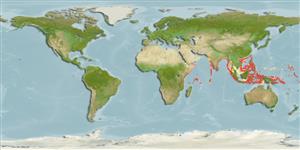
marin bathydémersal; profondeur 71 - 766 m (Ref. 10004). Deep-water; 22°N - 10°S
Indo-West Pacific: widely distributed but with spotty records from Tanzania, the Gulf of Aden, India (Gulf of Mannar, Bay of Bengal), Andaman Islands, Viet Nam, and the Philippines. The immense range of this species is striking compared to the limited ranges of other members of the genus.
Longueur à la première maturité / Taille / Poids / Âge
Maturité: Lm 15.5, range 15 - 16 cm
Max length : 23.0 cm TL mâle / non sexé; (Ref. 244); 24.0 cm TL (female)
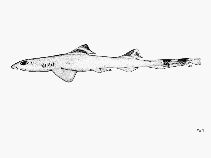
Épines dorsales (Total) : 0; Épines anales: 0. Caudal fin without a rippled dorsal margin and ventral lobe but with a strong subterminal notch; vertebral axis of caudal fin little raised above body axis (Ref. 13566). Dark brown with blackish markings on dorsal fins (Ref. 13566).
Body shape (shape guide): elongated.
Occurs over muddy bottoms, on the upper continental and insular slopes and outer shelves (Ref. 244). Feeds mainly on small bony fishes and crustaceans, with squid a lesser item in the diet (Ref. 244). One of the two smallest living sharks (Ref. 13566). Ovoviviparous (Ref. 50449), with 1 to 2 pups in a litter (Ref. 244).
Cycle de vie et comportement reproducteur
Maturité | Reproduction | Frai | Œufs | Fécondité | Larves
Ovoviviparous, embryos feed solely on yolk (Ref. 50449). 1-2 pups per litter, size at birth about 11 cm (Ref. 244).
Compagno, L.J.V., 1984. FAO Species Catalogue. Vol. 4. Sharks of the world. An annotated and illustrated catalogue of shark species known to date. Part 2 - Carcharhiniformes. FAO Fish. Synop. 125(4/2):251-655. Rome: FAO. (Ref. 244)
Statut dans la liste rouge de l'IUCN (Ref. 130435: Version 2025-2 (Global))
Utilisations par l'homme
Outils
Articles particuliers
Télécharger en XML
Sources Internet
Estimations basées sur des modèles
Température préférée (Réf.
123201): 9.3 - 18.6, mean 12.7 °C (based on 254 cells).
Indice de diversité phylogénétique (Réf.
82804): PD
50 = 0.6328 [Uniqueness, from 0.5 = low to 2.0 = high].
Bayesian length-weight: a=0.00288 (0.00112 - 0.00741), b=3.14 (2.91 - 3.37), in cm total length, based on LWR estimates for this (Sub)family-body shape (Ref.
93245).
Niveau trophique (Réf.
69278): 4.1 ±0.3 se; based on diet studies.
Résilience (Réf.
120179): Très faible, temps minimum de doublement de population supérieur à 14 ans (Fec=1).
Vulnérabilité de la pêche (Ref.
59153): Low vulnerability (14 of 100).
🛈
Nutriments (Ref.
124155): Calcium = 14.4 [2.4, 98.2] mg/100g; Iron = 0.371 [0.078, 1.303] mg/100g; Protein = 18.1 [16.0, 20.2] %; Omega3 = 0.235 [0.091, 0.594] g/100g; Selenium = 8.99 [2.70, 29.75] μg/100g; VitaminA = 35.1 [6.9, 180.5] μg/100g; Zinc = 0.462 [0.219, 0.922] mg/100g (wet weight);