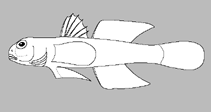
Classificação / Nomes
Nomes comuns | Sinônimos | Catalog of Fishes(Gênero, Espécies) | ITIS | CoL | WoRMS | Cloffa
>
Gobiiformes (Gobies) >
Gobiidae (Gobies) > Sicydiinae
Etymology: Stiphodon: Greek, stiphos, -eos, -oys = mass + Greek, odous = teeth (Ref. 45335); martenstyni: The new species is named in memory of Cedric Martenstyn, one of the many unfortunate victims of Sri Lanka's civil war. As a dedicated naturalist (Pethiyagoda, 1991), his interest will be greatly misses (Ref. 44827).
Eponymy: Cedric Douglas Martenstyn (1946–1996) was a naturalist and diver, a Lieutenant Commander in the Sri Lankan Navy and Commander of the Navy’s Special Boat Service during the civil war against the Tamil insurgents. [...] (Ref. 128868), visit book page.
Meio ambiente: milieu / Zona climática / intervalo de profundidade / faixa de distribuição
Ecologia
; Água doce demersal; anfídromo. Tropical
Asia: Sri Lanka. Known only from the southwestern part of the country (Ref. 44827).
Tamanho / Peso / Idade
Maturidade: Lm ? range ? - ? cm
Max length : 3.5 cm SL macho/indeterminado; (Ref. 104909)
Descrição suscinta
Chaves de identificação | Morfologia | Morfometria
Espinhos dorsais (total) : 7; Raios dorsais (total) : 9; Espinhos anais: 1; Raios anais : 10. Nine rays in second dorsal fin (Dorsal fin VI-I, 9). Fifteen pectoral rays. Scales in lateral series 34. Ten cycloid scales in predorsal midline. Forty-five tricuspid teeth in upper jaw. Cutaneous sensory papillae over head elongate. Upper lip crenulated. Ridge of tissue forming a ring around anus (Ref. 44827).
Body shape (shape guide): elongated.
Like other sicydiine gobies, Stiphodon martenstyni is probably amphidromous (McDowell, 1992a, 1992b). While juveniles and adults live exclusively in freshwater, adults reproduce in freshwater, the eggs being cared for by males. Eggs in all sicydiine gobies studied usually hatch in about 24 hours (Erdman, 1961, 1986; Beyer, 1989) at which time the fry passively drift downstream and out to sea where they become part of the plankton layer. The time spent out at sea as planktonic fry is unknown. The returning fry can be likened to surfers: that is, when fry are able to detect the crest of waves to their new home. This follows a similar scenario presented in Erdman (1961) for Sicydium Valenciennes, 1837 from Puerto Rico (Ref. 44827).
Ciclo de vida ou comportamento de acasalamento
Maturidade | Reprodução | Desova | Ovos | Fecundidade | Larvas
Watson, R.E., 1998. Stiphodon martenstyni, a new species of freshwater goby from Sri Lanka (Teleostei: Gobiidae: Sicydiini). J. South Asian Nat. Hist. 3(1):69-78. (Ref. 44827)
Status na Lista Vermelha da UICN (Ref. 130435: Version 2025-2 (Global))
Ameaça para os humanos
Harmless
Uso pelos humanos
Pescarias: sem interesse
Ferramentas
Relatórios especiais
Baixar XML
Fontes da internet
Estimativas baseadas em modelos
Índice de diversidade filogenética (Ref.
82804): PD
50 = 0.5000 [Uniqueness, from 0.5 = low to 2.0 = high].
Bayesian length-weight: a=0.00389 (0.00180 - 0.00842), b=3.12 (2.94 - 3.30), in cm total length, based on all LWR estimates for this body shape (Ref.
93245).
Resiliência (Ref.
120179): Elevada, tempo mínimo de duplicação da população menor que 15 meses (Preliminary K or Fecundity.).
Vulnerabilidade da pesca (Ref.
59153): Low vulnerability (10 of 100).
🛈