This website uses cookies to enhance your browsing experience and ensure the functionality of our site. For more detailed information about the types of cookies we use and how we protect your privacy, please visit our Privacy Information page.
×
Cookie Settings
This website uses different types of cookies to enhance your experience. Please select your preferences below:
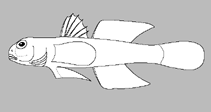
No image available for this species; drawing shows typical species in Gobiidae.
分类 / 名称 俗名 | 同种异名 | Catalog of Fishes(属, 种) | ITIS | CoL | WoRMS | Cloffa
Teleostei > Gobiiformes (Gobies) > Gobiidae (Gobies) > Sicydiinae
Etymology: Stiphodon:Greek, stiphos, -eos, -oys = mass + Greek, odous = teeth (Ref. 45335); martenstyni:The new species is named in memory of Cedric Martenstyn, one of the many unfortunate victims of Sri Lanka's civil war. As a dedicated naturalist (Pethiyagoda, 1991), his interest will be greatly misses (Ref. 44827). Eponymy: Cedric Douglas Martenstyn (1946–1996) was a naturalist and diver, a Lieutenant Commander in the Sri Lankan Navy and Commander of the Navy’s Special Boat Service during the civil war against the Tamil insurgents. [...] (Ref. 128868), visit book page.
背棘 (总数) : 7; 背的软条 (总数) : 9; 臀棘: 1; 臀鳍软条: 10. Nine rays in second dorsal fin (Dorsal fin VI-I, 9). Fifteen pectoral rays. Scales in lateral series 34. Ten cycloid scales in predorsal midline. Forty-five tricuspid teeth in upper jaw. Cutaneous sensory papillae over head elongate. Upper lip crenulated. Ridge of tissue forming a ring around anus (Ref. 44827). Body shape (shape guide): elongated.
Like other sicydiine gobies, Stiphodon martenstyni is probably amphidromous (McDowell, 1992a, 1992b). While juveniles and adults live exclusively in freshwater, adults reproduce in freshwater, the eggs being cared for by males. Eggs in all sicydiine gobies studied usually hatch in about 24 hours (Erdman, 1961, 1986; Beyer, 1989) at which time the fry passively drift downstream and out to sea where they become part of the plankton layer. The time spent out at sea as planktonic fry is unknown. The returning fry can be likened to surfers: that is, when fry are able to detect the crest of waves to their new home. This follows a similar scenario presented in Erdman (1961) for Sicydium Valenciennes, 1837 from Puerto Rico (Ref. 44827).
Watson, R.E., 1998. Stiphodon martenstyni, a new species of freshwater goby from Sri Lanka (Teleostei: Gobiidae: Sicydiini). J. South Asian Nat. Hist. 3(1):69-78. (Ref. 44827)
世界自然保护联盟红皮书 (Ref. 130435: Version 2025-2 (Global))
极度濒危 (CR) (B1ab(iii)+2ab(iii)); Date assessed: 06 August 2019
系统发育多样性指数 (参考文献 82804): PD50 = 0.5000 [Uniqueness, from 0.5 = low to 2.0 = high].
Bayesian length-weight: a=0.00389 (0.00180 - 0.00842), b=3.12 (2.94 - 3.30), in cm total length, based on all LWR estimates for this body shape (Ref. 93245).
回复力 (参考文献 120179): 高度, 族群倍增时间少于 15个月 (Preliminary K or Fecundity.).
渔业脆弱性 (Ref. 59153): Low vulnerability (10 of 100). 🛈