>
Syngnathiformes (Pipefishes and seahorses) >
Syngnathidae (Pipefishes and seahorses) > Syngnathinae
Etymology: Hippocampus: Greek, ippos = horse + Greek,kampe = curvature (Ref. 45335).
More on author: Kaup.
Ambiente: milieu / zona climatica / distribuzione batimetrica / gamma di distribuzione
Ecologia
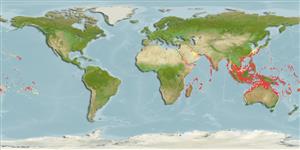
marino associati a barriera corallina; non migratori (Ref. 52884); distribuzione batimetrica 0 - 82 m (Ref. 37816), usually 15 - 40 m (Ref. 90102). Tropical; 35°N - 35°S, 22°E - 132°W
Indo-Pacific: South Africa to French Polynesia; north to Japan, south to Australia. Not in the Red Sea.
Lunghezza alla prima maturità / Dimensione / Peso / Età
Maturità: Lm 7.9 range ? - ? cm
Max length : 17.0 cm TL maschio/sesso non determinato; (Ref. 11441)
Breve descrizione
Chiavi di identificazione | Morfologia | Morfometria
Spine dorsali (totale) : 0; Raggi dorsali molli (totale) : 15 - 18; Spine anali: 0; Raggi anali molli: 4.
Body shape (shape guide): other.
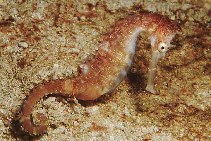
A rare inhabitant of shallow sheltered reefs, found among clumps of algae or in seagrass beds. Large adult pelagic and probably associated with drifting debris. Associated with sponges and sea-squirts (Ref. 30915, 58302). Ovoviviparous (Ref. 205). Feeds on zooplanktons and small crustaceans (Ref. 89972). The male carries the eggs in a brood pouch which is found under the tail (Ref. 205). Monogamous and always in home-ranging pairs, that is they do not defend an exclusive territory (Ref. 52884). Use in traditional Chinese medicine is increasing with the rise in patent medicines (Ref. 30915). Not common in the aquarium trade (Ref. 30915). Minimum depth reported taken from Ref. 128812.
Ciclo vitale e comportamento di accoppiamento
Maturità | Riproduzione | Deposizione | Uova | Fecondità | Larve
Monogamous mating is observed as both obligate and genetic (Ref. 52884). Male carries the eggs in a brood pouch (Ref. 205).
Lourie, S.A., R.A. Pollom and S.J. Foster, 2016. A global revision of the seahorses Hippocampus Rafinesque 1810 (Actinopterygii: Syngnathiformes): taxonomy and biogeography with recommendations for further research. Zootaxa 4146(1):1-66. (Ref. 115213)
Stato della Lista Rossa IUCN (Ref. 130435: Version 2025-2 (Global))
Minaccia per l'uomo
Harmless
Usi umani
Pesca: elevato interesse commerciale; Acquario: Commerciale
Strumenti
Rapporti speciali
Scarica XML
Fonti Internet
Stime basate su modelli
Temperatura preferita (Fonte Biblio.
123201): 24.4 - 29, mean 28.1 °C (based on 1240 cells).
Indice di diversità filogenetica (Fonte Biblio.
82804): PD
50 = 0.5000 [Uniqueness, from 0.5 = low to 2.0 = high].
Bayesian length-weight: a=0.00447 (0.00176 - 0.01132), b=3.00 (2.78 - 3.22), in cm total length, based on LWR estimates for this (Sub)family-body shape (Ref.
93245).
Livello trofico (Fonte Biblio.
69278): 3.5 ±0.53 se; based on food items.
Resilienza (Fonte Biblio.
120179): Alto, tempo minimo di raddoppiamento della popolazione meno di 15 mesi (Preliminary K or Fecundity.).
Vulnerabilità della pesca (Ref.
59153): Low vulnerability (10 of 100).
🛈
Nutrienti (Ref.
124155): Calcium = 102 [59, 196] mg/100g; Iron = 0.824 [0.481, 1.489] mg/100g; Protein = 18 [17, 19] %; Omega3 = 0.13 [0.08, 0.23] g/100g; Selenium = 41.6 [21.8, 91.3] μg/100g; VitaminA = 74.7 [25.4, 214.0] μg/100g; Zinc = 1.57 [1.07, 2.21] mg/100g (wet weight);