>
Syngnathiformes (Pipefishes and seahorses) >
Syngnathidae (Pipefishes and seahorses) > Syngnathinae
Etymology: Hippocampus: Greek, ippos = horse + Greek,kampe = curvature (Ref. 45335).
More on author: Kaup.
Entorno: milieu / zona climática / rango de profundidad / gama de distribución
Ecología
marino asociado a arrecife; no migratorio (Ref. 52884); rango de profundidad 0 - 82 m (Ref. 37816), usually 15 - 40 m (Ref. 90102). Tropical; 35°N - 35°S, 22°E - 132°W
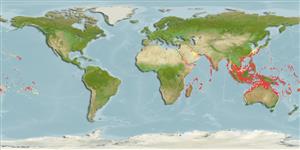
Indo-Pacific: South Africa to French Polynesia; north to Japan, south to Australia. Not in the Red Sea.
Longitud en la primera madurez / Tamaño / Peso / Edad
Madurez: Lm 7.9 range ? - ? cm
Max length : 17.0 cm TL macho / no sexado; (Ref. 11441)
Descripción breve
Claves de identificación | Morfología | Morfometría
Espinas dorsales (total) : 0; Radios blandos dorsales (total) : 15 - 18; Espinas anales: 0; Radios blandos anales: 4.
Body shape (shape guide): other.
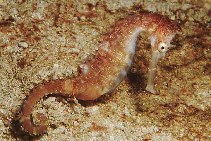
A rare inhabitant of shallow sheltered reefs, found among clumps of algae or in seagrass beds. Large adult pelagic and probably associated with drifting debris. Associated with sponges and sea-squirts (Ref. 30915, 58302). Ovoviviparous (Ref. 205). Feeds on zooplanktons and small crustaceans (Ref. 89972). The male carries the eggs in a brood pouch which is found under the tail (Ref. 205). Monogamous and always in home-ranging pairs, that is they do not defend an exclusive territory (Ref. 52884). Use in traditional Chinese medicine is increasing with the rise in patent medicines (Ref. 30915). Not common in the aquarium trade (Ref. 30915). Minimum depth reported taken from Ref. 128812.
Ciclo vital y comportamiento de apareamiento
Madurez | Reproducción | Puesta | Huevos | Fecundidad | Larva
Monogamous mating is observed as both obligate and genetic (Ref. 52884). Male carries the eggs in a brood pouch (Ref. 205).
Lourie, S.A., R.A. Pollom and S.J. Foster, 2016. A global revision of the seahorses Hippocampus Rafinesque 1810 (Actinopterygii: Syngnathiformes): taxonomy and biogeography with recommendations for further research. Zootaxa 4146(1):1-66. (Ref. 115213)
Situación en la Lista Roja de la UICN (Ref. 130435: Version 2025-2 (Global))
Amenaza para el ser humano
Harmless
Usos humanos
Pesquerías: muy comercial; Acuario: Comercial
Herramientas
Informes especiales
Descargar XML
Fuentes de Internet
Estimaciones basadas en modelos
Temperatura preferida (Referencia
123201): 24.4 - 29, mean 28.1 °C (based on 1240 cells).
Índice de diversidad filogenética (Referencia
82804): PD
50 = 0.5000 [Uniqueness, from 0.5 = low to 2.0 = high].
Bayesian length-weight: a=0.00447 (0.00176 - 0.01132), b=3.00 (2.78 - 3.22), in cm total length, based on LWR estimates for this (Sub)family-body shape (Ref.
93245).
Nivel trófico (Referencia
69278): 3.5 ±0.53 se; based on food items.
Resiliencia (Referencia
120179): Alto, población duplicada en un tiempo mínimo inferior a 15 meses (Preliminary K or Fecundity.).
Vulnerabilidad pesquera (Ref.
59153): Low vulnerability (10 of 100).
🛈
Nutrientes (Ref.
124155): Calcium = 102 [59, 196] mg/100g; Iron = 0.824 [0.481, 1.489] mg/100g; Protein = 18 [17, 19] %; Omega3 = 0.13 [0.08, 0.23] g/100g; Selenium = 41.6 [21.8, 91.3] μg/100g; VitaminA = 74.7 [25.4, 214.0] μg/100g; Zinc = 1.57 [1.07, 2.21] mg/100g (wet weight);