>
Syngnathiformes (Pipefishes and seahorses) >
Syngnathidae (Pipefishes and seahorses) > Syngnathinae
Etymology: Corythoichthys: Greek, korys, korythos = helmet + Greek, ichtys = fish (Ref. 45335).
More on author: Ramsay.
Taxonomic Remarks
The species Corythoichthys waitei Jordan & Seale, 1906 is considered as valid in Eschmeyer (CofF ver. Mar. 2011: Ref. 86697) following Allen & Erdmann (2008: Ref. 74959).
Environnement : milieu / zone climatique / profondeur / gamme de distribution
Écologie
marin récifal; non migrateur (Ref. 52884); profondeur 20 - 68 m (Ref. 9710), usually ? - 68 m (Ref. 37816). Tropical; 16°N - 23°S
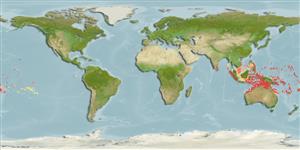
Western Central Pacific: Borneo to Samoa, north to Marshall and Mariana Islands, south to Rowley Shoals and New Caledonia; throughout Micronesia.
Taille / Poids / Âge
Maturité: Lm ? range ? - ? cm
Max length : 17.8 cm SL mâle / non sexé; (Ref. 137577)
Description synthétique
Clés d'identification | Morphologie | Morphométrie
Épines dorsales (Total) : 0; Rayons mous dorsaux (Total) : 26 - 32; Rayons mous anaux: 4.
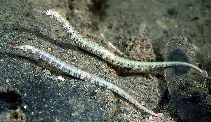
Body shape (shape guide): eel-like; Cross section: angular.
Adults occur in shallow sandy or mixed sand, rubble, or coral areas of reef flats and lagoons, also sometimes on seaward reefs (Ref. 1602). Ovoviviparous (Ref. 205). The male carries the eggs in a brood pouch which is found under the tail (Ref. 205). Males may be brooding at 6.5-7.0 cm SL. Usually in pairs or may form small aggregations (Ref 90102). Monogamous and always in home-ranging pairs, that is they do not defend an exclusive territory (Ref. 52884).
Cycle de vie et comportement reproducteur
Maturité | Reproduction | Frai | Œufs | Fécondité | Larves
Monogamous mating is observed as both obligate and genetic (Ref. 52884). Male carries the eggs in a brood pouch (Ref. 205).
Dawson, C.E., 1985. Indo-Pacific pipefishes (Red Sea to the Americas). The Gulf Coast Research Laboratory Ocean Springs, Mississippi, USA. (Ref. 5316)
Statut dans la liste rouge de l'IUCN (Ref. 130435: Version 2025-2 (Global))
Menace pour l'homme
Harmless
Utilisations par l'homme
Pêcheries: sans intérêt; Aquarium: Aquariums publics
Outils
Articles particuliers
Télécharger en XML
Sources Internet
Estimations basées sur des modèles
Température préférée (Réf.
123201): 25.3 - 28.7, mean 26.9 °C (based on 122 cells).
Indice de diversité phylogénétique (Réf.
82804): PD
50 = 0.5001 [Uniqueness, from 0.5 = low to 2.0 = high].
Bayesian length-weight: a=0.00035 (0.00015 - 0.00079), b=3.19 (3.00 - 3.38), in cm total length, based on LWR estimates for this (Sub)family-body shape (Ref.
93245).
Niveau trophique (Réf.
69278): 3.2 ±0.2 se; based on diet studies.
Résilience (Réf.
120179): Haut, temps minimum de doublement de population inférieur à 15 mois (Preliminary K or Fecundity.).
Vulnérabilité de la pêche (Ref.
59153): Low vulnerability (12 of 100).
🛈
Nutriments (Ref.
124155): Calcium = 105 [60, 194] mg/100g; Iron = 0.815 [0.486, 1.423] mg/100g; Protein = 17.8 [16.7, 19.0] %; Omega3 = 0.123 [0.073, 0.215] g/100g; Selenium = 38.3 [20.1, 82.5] μg/100g; VitaminA = 81.3 [26.9, 230.7] μg/100g; Zinc = 1.68 [1.16, 2.34] mg/100g (wet weight);