>
Perciformes/Cottoidei (Sculpins) >
Liparidae (Snailfishes)
Etymology: Psednos: Greek, psednos, -e, -on = rare (Ref. 45335); micruroides: From Barnard's original specific name micrurus, and used because of the similarity between the two species (Ref. 42989).
More on author: Chernova.
Environnement : milieu / zone climatique / profondeur / gamme de distribution
Écologie
marin bathypélagique; profondeur 0 - 900 m (Ref. 42989). Deep-water
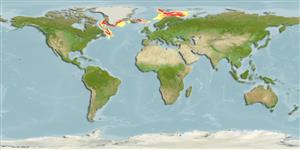
Northeast Atlantic: southeast of Greenland.
Taille / Poids / Âge
Maturité: Lm ? range ? - ? cm
Max length : 3.1 cm SL mâle / non sexé; (Ref. 42989)
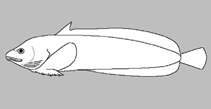
Rayons mous dorsaux (Total) : 38; Rayons mous anaux: 30; Vertèbres: 43. Coronal pore present, 6th infraorbital pore absent, 3-4 pores in temporal canal; eye 22.7% HL, mouth terminal, and gill slit equal to eye diameter (Ref. 42989).
Caught in a midwater trawl (Ref. 42989). Reported maximum length of 3.1 cm SL was based on a subadult specimen (Ref. 42989). Preliminary maximum length assumed as 6.5 cm TL.
Cycle de vie et comportement reproducteur
Maturité | Reproduction | Frai | Œufs | Fécondité | Larves
Chernova, N., 2001. A review of the genus Psednos (Pisces, Liparidae) with description of ten new species from the north Atlantic and southwestern Indian Ocean. Bull. Mus. Comp. Zool. 155(10):477-507. (Ref. 42989)
Statut dans la liste rouge de l'IUCN (Ref. 130435: Version 2025-2 (Global))
Menace pour l'homme
Harmless
Utilisations par l'homme
Outils
Articles particuliers
Télécharger en XML
Sources Internet
Estimations basées sur des modèles
Température préférée (Réf.
123201): -0.9 - 4.8, mean 1.2 °C (based on 274 cells).
Indice de diversité phylogénétique (Réf.
82804): PD
50 = 0.5000 [Uniqueness, from 0.5 = low to 2.0 = high].
Bayesian length-weight: a=0.00525 (0.00237 - 0.01161), b=3.15 (2.96 - 3.34), in cm total length, based on LWR estimates for this (Sub)family-body shape (Ref.
93245).
Niveau trophique (Réf.
69278): 3.1 ±0.5 se; based on size and trophs of closest relatives
Résilience (Réf.
120179): Milieu, temps minimum de doublement de population : 1,4 à 4,4 années (Fecundity assumed < 1000).
Vulnérabilité de la pêche (Ref.
59153): Low vulnerability (10 of 100).
🛈