>
Perciformes/Cottoidei (Sculpins) >
Liparidae (Snailfishes)
Etymology: Psednos: Greek, psednos, -e, -on = rare (Ref. 45335); micruroides: From Barnard's original specific name micrurus, and used because of the similarity between the two species (Ref. 42989).
More on author: Chernova.
Umwelt: Milieu / Klimazone / Tiefenbereich / Verbreitungsgebiet
Ökologie
seewasser bathypelagisch; tiefenbereich 0 - 900 m (Ref. 42989). Deep-water
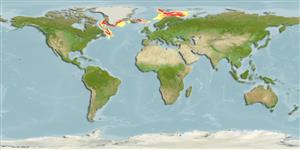
Northeast Atlantic: southeast of Greenland.
Größe / Gewicht / Alter
Geschlechtsreife: Lm ? range ? - ? cm
Max length : 3.1 cm SL Männchen/unbestimmt; (Ref. 42989)
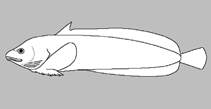
Rückenflossenweichstrahlen (insgesamt) : 38; Afterflossenweichstrahlen: 30; Wirbelzahl: 43. Coronal pore present, 6th infraorbital pore absent, 3-4 pores in temporal canal; eye 22.7% HL, mouth terminal, and gill slit equal to eye diameter (Ref. 42989).
Caught in a midwater trawl (Ref. 42989). Reported maximum length of 3.1 cm SL was based on a subadult specimen (Ref. 42989). Preliminary maximum length assumed as 6.5 cm TL.
Lebenszyklus und Paarungsverhalten
Geschlechtsreife | Fortpflanzung | Ablaichen | Eier | Fruchtbarkeit | Larven
Chernova, N., 2001. A review of the genus Psednos (Pisces, Liparidae) with description of ten new species from the north Atlantic and southwestern Indian Ocean. Bull. Mus. Comp. Zool. 155(10):477-507. (Ref. 42989)
IUCN Rote Liste Status (Ref. 130435: Version 2025-2 (Global))
Bedrohung für Menschen
Harmless
Nutzung durch Menschen
Tools
Zusatzinformationen
Download XML
Internet Quellen
Schätzungen auf der Grundlage von Modellen
Bevorzugte Temperatur (Ref.
123201): -0.9 - 4.8, mean 1.2 °C (based on 274 cells).
Phylogenetischer Diversitätsindex (Ref.
82804): PD
50 = 0.5000 [Uniqueness, from 0.5 = low to 2.0 = high].
Bayesian length-weight: a=0.00525 (0.00237 - 0.01161), b=3.15 (2.96 - 3.34), in cm total length, based on LWR estimates for this (Sub)family-body shape (Ref.
93245).
Trophische Ebene (Ref.
69278): 3.1 ±0.5 se; based on size and trophs of closest relatives
Widerstandsfähigkeit (Ref.
120179): mittel, Verdopplung der Population dauert 1,4 - 4,4 Jahre. (Fecundity assumed < 1000).
Anfälligkeit der Fischerei (Ref.
59153): Low vulnerability (10 of 100).
🛈