>
Siluriformes (Catfishes) >
Plotosidae (Eeltail catfishes)
Etymology: Paraplotosus: Greek, para = in the side of + Greek, plotos = swimming (Ref. 45335); butleri: Named in honor of W. 'Harry' Butler, who assisted in with the collection of many of the paratypes (Ref. 31103).
Eponymy: Dr William Henry ‘Harry’ Butler (1930–2015) was born in Perth and trained as a teacher. [...] (Ref. 128868), visit book page.
Umwelt: Milieu / Klimazone / Tiefenbereich / Verbreitungsgebiet
Ökologie
seewasser riff-verbunden; tiefenbereich 0 - 5 m (Ref. 31103). Tropical
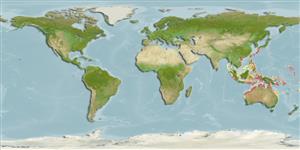
Indo-West Pacific: northern Australia.
Größe / Gewicht / Alter
Geschlechtsreife: Lm ? range ? - ? cm
Max length : 32.5 cm SL Männchen/unbestimmt; (Ref. 31103)
Kurzbeschreibung
Bestimmungsschlüssel | Morphologie | Morphometrie
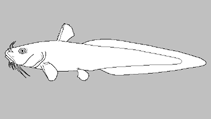
Rückenflossenstacheln (insgesamt) : 1; Rückenflossenweichstrahlen (insgesamt) : 115 - 130; Afterflossenstacheln: 0; Afterflossenweichstrahlen: 87 - 102. Differs from Paraplotosus albilabris and P. muelleri in having a tall, sail-like first dorsal fin and extremely long nasal barbels, which extend posteriorly to the basal third of the pectoral fin or beyond (Ref. 31103). Small juveniles have a unique coloration consisting of a black head and body with a broad white to yellow margin on the first dorsal fin and continuous dorsal-caudal-anal fin (Ref. 31103). Adults entirely black (Ref. 31103).
Body shape (shape guide): elongated.
Restricted to coastal reefs (Ref. 31103). Secretive, found in reef holes or under large rocks (Ref. 31103). Presumably nocturnal (Ref. 31103). Feeds on gastropod mollusks and crustaceans (Ref. 31103).
Lebenszyklus und Paarungsverhalten
Geschlechtsreife | Fortpflanzung | Ablaichen | Eier | Fruchtbarkeit | Larven
Allen, G.R., 1998. A review of the marine catfish genus Paraplotosus (Plotosidae) with the description of a new species from north-western Australia. Raf. Bull. Zool. 46(1):123-134. (Ref. 31103)
IUCN Rote Liste Status (Ref. 130435: Version 2025-2 (Global))
Bedrohung für Menschen
Harmless
Nutzung durch Menschen
Tools
Zusatzinformationen
Download XML
Internet Quellen
Schätzungen auf der Grundlage von Modellen
Bevorzugte Temperatur (Ref.
123201): 24.4 - 29.2, mean 28.3 °C (based on 1313 cells).
Phylogenetischer Diversitätsindex (Ref.
82804): PD
50 = 0.6250 [Uniqueness, from 0.5 = low to 2.0 = high].
Bayesian length-weight: a=0.00468 (0.00210 - 0.01040), b=3.06 (2.86 - 3.26), in cm total length, based on LWR estimates for this (Sub)family-body shape (Ref.
93245).
Trophische Ebene (Ref.
69278): 3.4 ±0.54 se; based on food items.
Widerstandsfähigkeit (Ref.
120179): hoch, Verdopplung der Population dauert weniger als 15 Monate. (Preliminary K or Fecundity.).
Anfälligkeit der Fischerei (Ref.
59153): Low to moderate vulnerability (30 of 100).
🛈
Nährstoffe (Ref.
124155): Calcium = 72.2 [30.7, 143.8] mg/100g; Iron = 0.624 [0.353, 1.158] mg/100g; Protein = 17.1 [15.1, 19.2] %; Omega3 = 0.0826 [, ] g/100g; Selenium = 22.7 [11.9, 53.1] μg/100g; VitaminA = 90.5 [29.0, 264.8] μg/100g; Zinc = 1.34 [0.90, 1.92] mg/100g (wet weight);