>
Siluriformes (Catfishes) >
Plotosidae (Eeltail catfishes)
Etymology: Paraplotosus: Greek, para = in the side of + Greek, plotos = swimming (Ref. 45335); butleri: Named in honor of W. 'Harry' Butler, who assisted in with the collection of many of the paratypes (Ref. 31103).
Eponymy: Dr William Henry ‘Harry’ Butler (1930–2015) was born in Perth and trained as a teacher. [...] (Ref. 128868), visit book page.
Entorno: milieu / zona climática / rango de profundidad / gama de distribución
Ecología
marino asociado a arrecife; rango de profundidad 0 - 5 m (Ref. 31103). Tropical
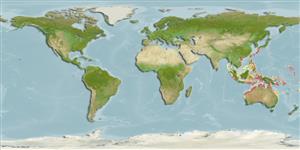
Indo-West Pacific: northern Australia.
Tamaño / Peso / Edad
Madurez: Lm ? range ? - ? cm
Max length : 32.5 cm SL macho / no sexado; (Ref. 31103)
Descripción breve
Claves de identificación | Morfología | Morfometría
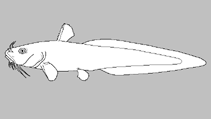
Espinas dorsales (total) : 1; Radios blandos dorsales (total) : 115 - 130; Espinas anales: 0; Radios blandos anales: 87 - 102. Differs from Paraplotosus albilabris and P. muelleri in having a tall, sail-like first dorsal fin and extremely long nasal barbels, which extend posteriorly to the basal third of the pectoral fin or beyond (Ref. 31103). Small juveniles have a unique coloration consisting of a black head and body with a broad white to yellow margin on the first dorsal fin and continuous dorsal-caudal-anal fin (Ref. 31103). Adults entirely black (Ref. 31103).
Body shape (shape guide): elongated.
Restricted to coastal reefs (Ref. 31103). Secretive, found in reef holes or under large rocks (Ref. 31103). Presumably nocturnal (Ref. 31103). Feeds on gastropod mollusks and crustaceans (Ref. 31103).
Ciclo vital y comportamiento de apareamiento
Madurez | Reproducción | Puesta | Huevos | Fecundidad | Larva
Allen, G.R., 1998. A review of the marine catfish genus Paraplotosus (Plotosidae) with the description of a new species from north-western Australia. Raf. Bull. Zool. 46(1):123-134. (Ref. 31103)
Situación en la Lista Roja de la UICN (Ref. 130435: Version 2025-2 (Global))
Amenaza para el ser humano
Harmless
Usos humanos
Herramientas
Informes especiales
Descargar XML
Fuentes de Internet
Estimaciones basadas en modelos
Temperatura preferida (Referencia
123201): 24.4 - 29.2, mean 28.3 °C (based on 1313 cells).
Índice de diversidad filogenética (Referencia
82804): PD
50 = 0.6250 [Uniqueness, from 0.5 = low to 2.0 = high].
Bayesian length-weight: a=0.00468 (0.00210 - 0.01040), b=3.06 (2.86 - 3.26), in cm total length, based on LWR estimates for this (Sub)family-body shape (Ref.
93245).
Nivel trófico (Referencia
69278): 3.4 ±0.54 se; based on food items.
Resiliencia (Referencia
120179): Alto, población duplicada en un tiempo mínimo inferior a 15 meses (Preliminary K or Fecundity.).
Vulnerabilidad pesquera (Ref.
59153): Low to moderate vulnerability (30 of 100).
🛈
Nutrientes (Ref.
124155): Calcium = 72.2 [30.7, 143.8] mg/100g; Iron = 0.624 [0.353, 1.158] mg/100g; Protein = 17.1 [15.1, 19.2] %; Omega3 = 0.0826 [, ] g/100g; Selenium = 22.7 [11.9, 53.1] μg/100g; VitaminA = 90.5 [29.0, 264.8] μg/100g; Zinc = 1.34 [0.90, 1.92] mg/100g (wet weight);