>
Osteoglossiformes (Bony tongues) >
Mormyridae (Elephantfishes)
Etymology: Petrocephalus: Latin, petra = stone + Greek, kephale = head (Ref. 45335); sullivani: This species is dedicated to John P. Sullivan, colleague and friend of the authors, in recognition of his contributions to the systematics of the Mormyridae.
Eponymy: Dr John P Sullivan (d: 1965) is an ichthyologist who is (2013–present) a Curatorial Affiliate at Cornell University, Museum of Vertebrates Ithaca, NY, USA where he had previously been a visiting fellow (2009–2013). [...] (Ref. 128868), visit book page.
Περιβάλλον: περιβάλλον / κλιματική ζώνη / εύρος βάθους / εύρος διανομής
Οικολογία
; Γλυκού νερού βενθοπελαγικό. Tropical
Africa: Widespread in Gabon. It has been collected from the Ogooué basin (excepting its most upper and lower reaches), the Ntem and Ivindo basins, and the Nyanga basin. On numerous occasions, the authors collected this species together with P. simus (Ref. 52344).
Μέγεθος / Βάρος / Ηλικία
Γεννητική Ωρίμανση: Lm ? range ? - ? cm
Max length : 9.3 cm SL αρσενικό/απροσδιόριστο; (Ref. 52344)
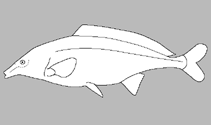
Petrocephalus sullivani is distinguished from all other Petrocephalus species from Gabon by the following characters: 20 to 25 branched rays in the dorsal fin and 24 to 30 in the anal fin; 14 to 20 scales (average 17.5) between the anterior base of the anal fin and the lateral line; mouth clearly inferior (distance between anterior extremityof th esnout and corner of the mouth between 2.7 and 4.4 times in head length; mouth opens under the posterior half of the eye, whereas in P. simus and P. balayi it opens under the anterior half of the eye); large eye (diameter of the eye between 3.0 and 4.1 times in head length, average 3.6); and no sub-dorsal black spot. The EOD is short (216 ms mean duration) with a peak FFT frequency of 9597 Hz. The EOD presents a prominent third phase (P3) with an amplitude of 12.8% of peak-to-peak height. Eye relatively large. Eye diameter between 3.0 and 4.1 times in head length (average 3.5) (Ref. 52344).
Body shape (shape guide): fusiform / normal; Cross section: compressed.
Κύκλος ζωής και συμπεριφορά ζευγαρώματος
Γεννητική Ωρίμανση | Αναπαραγωγή | Γεννοβολία | Αβγά | Γονιμότητα | Προνύμφες
Lavoué, S., C.D. Hopkins and A. Kamdem Toham, 2004. The Petrocephalus (Pisces, Osteoglossomorpha, Mormyridae) of Gabon, Central Africa, with the description of a new species. Zoosystema 26(3):511-535. (Ref. 52344)
Κατάσταση Κόκκινου Καταλόγου IUCN (Ref. 130435: Version 2025-2 (Global))
Απειλή για τον άνθρωπο
Harmless
Ανθρώπινες χρήσεις
Εργαλεία
Ειδικές εκθέσεις
Λήψη XML
Διαδικτυακές πηγές
Εκτιμήσεις βάσει μοντέλων
Δείκτης φυλογενετικής ποικιλότητας (Αναφ.
82804): PD
50 = 0.5000 [Uniqueness, from 0.5 = low to 2.0 = high].
Bayesian length-weight: a=0.01549 (0.00672 - 0.03569), b=2.87 (2.69 - 3.05), in cm total length, based on LWR estimates for this Genus-body shape (Ref.
93245).
Τροφικό Επίπεδο (Αναφ.
69278): 3.2 ±0.4 se; based on size and trophs of closest relatives
Ελαστικότητα (Αναφ.
120179): Υψηλό, ελάχιστος χρόνος για διπλασιασμό πληθυσμού < 15 μήνες (Preliminary K or Fecundity.).
Ευπάθεια στην αλιεία (Ref.
59153): Low vulnerability (10 of 100).
🛈