>
Osteoglossiformes (Bony tongues) >
Mormyridae (Elephantfishes)
Etymology: Petrocephalus: Latin, petra = stone + Greek, kephale = head (Ref. 45335); sullivani: This species is dedicated to John P. Sullivan, colleague and friend of the authors, in recognition of his contributions to the systematics of the Mormyridae.
Eponymy: Dr John P Sullivan (d: 1965) is an ichthyologist who is (2013–present) a Curatorial Affiliate at Cornell University, Museum of Vertebrates Ithaca, NY, USA where he had previously been a visiting fellow (2009–2013). [...] (Ref. 128868), visit book page.
Ambiente: milieu / zona climatica / distribuzione batimetrica / gamma di distribuzione
Ecologia
; acqua dolce benthopelagico. Tropical
Africa: Widespread in Gabon. It has been collected from the Ogooué basin (excepting its most upper and lower reaches), the Ntem and Ivindo basins, and the Nyanga basin. On numerous occasions, the authors collected this species together with P. simus (Ref. 52344).
Dimensione / Peso / Età
Maturità: Lm ? range ? - ? cm
Max length : 9.3 cm SL maschio/sesso non determinato; (Ref. 52344)
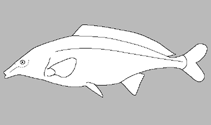
Petrocephalus sullivani is distinguished from all other Petrocephalus species from Gabon by the following characters: 20 to 25 branched rays in the dorsal fin and 24 to 30 in the anal fin; 14 to 20 scales (average 17.5) between the anterior base of the anal fin and the lateral line; mouth clearly inferior (distance between anterior extremityof th esnout and corner of the mouth between 2.7 and 4.4 times in head length; mouth opens under the posterior half of the eye, whereas in P. simus and P. balayi it opens under the anterior half of the eye); large eye (diameter of the eye between 3.0 and 4.1 times in head length, average 3.6); and no sub-dorsal black spot. The EOD is short (216 ms mean duration) with a peak FFT frequency of 9597 Hz. The EOD presents a prominent third phase (P3) with an amplitude of 12.8% of peak-to-peak height. Eye relatively large. Eye diameter between 3.0 and 4.1 times in head length (average 3.5) (Ref. 52344).
Body shape (shape guide): fusiform / normal; Cross section: compressed.
Ciclo vitale e comportamento di accoppiamento
Maturità | Riproduzione | Deposizione | Uova | Fecondità | Larve
Lavoué, S., C.D. Hopkins and A. Kamdem Toham, 2004. The Petrocephalus (Pisces, Osteoglossomorpha, Mormyridae) of Gabon, Central Africa, with the description of a new species. Zoosystema 26(3):511-535. (Ref. 52344)
Stato della Lista Rossa IUCN (Ref. 130435: Version 2025-2 (Global))
Minaccia per l'uomo
Harmless
Usi umani
Strumenti
Rapporti speciali
Scarica XML
Fonti Internet
Stime basate su modelli
Indice di diversità filogenetica (Fonte Biblio.
82804): PD
50 = 0.5000 [Uniqueness, from 0.5 = low to 2.0 = high].
Bayesian length-weight: a=0.01549 (0.00672 - 0.03569), b=2.87 (2.69 - 3.05), in cm total length, based on LWR estimates for this Genus-body shape (Ref.
93245).
Livello trofico (Fonte Biblio.
69278): 3.2 ±0.4 se; based on size and trophs of closest relatives
Resilienza (Fonte Biblio.
120179): Alto, tempo minimo di raddoppiamento della popolazione meno di 15 mesi (Preliminary K or Fecundity.).
Vulnerabilità della pesca (Ref.
59153): Low vulnerability (10 of 100).
🛈