Environnement : milieu / zone climatique / profondeur / gamme de distribution
Écologie
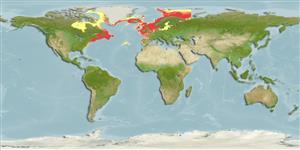
marin benthopélagique; océanodrome (Ref. 51243); profondeur 0 - 868 m (Ref. 58496), usually 50 - 150 m (Ref. 4701). Polar; 3°C - 11°C (Ref. 127841); 80°N - 32°N, 95°W - 49°E
Western Atlantic: Nunavut, Hudson Bay to James Bay and Labrador in Canada to New Jersey in USA; rarely to Chesapeake Bay in USA and Bermuda. Eastern Atlantic: Barents Sea, Iceland and Greenland to Spain (Ref. 4701).
Taille / Poids / Âge
Maturité: Lm ? range ? - ? cm
Max length : 61.0 cm TL mâle / non sexé; (Ref. 58426); 42.9 cm SL (female); poids max. publié: 9.5 kg (Ref. 4701); poids max. publié: 9.5 kg; âge max. reporté: 13 années (Ref. 54207)
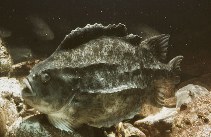
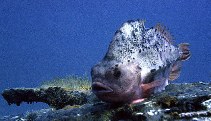
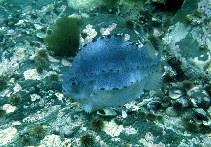
Épines dorsales (Total) : 5 - 9; Rayons mous dorsaux (Total) : 9 - 11; Épines anales: 0; Rayons mous anaux: 9 - 10; Vertèbres: 28 - 29. First dorsal fin present but covered by thick layer of skin forming a characteristic high crest with embedded spines. Bony tubercles present, arranged in 3 widely separated rows of large flattened tubercles on each side of body. Gill openings large, extend- extending below level of upper pectoral fin ray. Pyloric present 36-79. Ventral sucking disc formed by the modified pelvic fin (Ref. 232).
Body shape (shape guide): short and / or deep; Cross section: angular.
Basically solitary rather than a schooling fish. They exhibit a homing instinct (Ref. 9737). Adults inhabit rocky bottoms but may occur among floating seaweed. They migrate considerable distances in an annual cycle between deeper waters in winter and shallower waters in summer (Ref. 26141). Maximum depth reported at 868 m (Ref. 58426). Epibenthic-pelagic (Ref. 58426). Juveniles are found among algal clumps in bays and fjords moving offshore as they mature (Ref. 96431). During the spawning season the males become reddish in color on the underside, whereas females turn blue-green. Adults feed on ctenophores, medusas, small crustaceans, polychaetes, jelly fish and small fishes. Valued for their eggs, which make an inexpensive caviar (Ref. 9988). Eaten in Nordic countries, marketed fresh or smoked. Male flesh is most demanded and roe is sold fresh (Ref. 35388).
Eggs are laid in large numbers on stony bottoms (Ref. 9900). Male guards egg-mass aggressively.
Stein, D.L., 1986. Cyclopteridae. p. 1269-1274. In P.J.P. Whitehead, M.-L. Bauchot, J.-C. Hureau, J. Nielsen and E. Tortonese (eds.) Fishes of the North-eastern Atlantic and the Mediterranean. UNESCO, Paris. Vol. III. (Ref. 4701)
Statut dans la liste rouge de l'IUCN (Ref. 130435: Version 2025-2 (Global))
Menace pour l'homme
Harmless
Utilisations par l'homme
Pêcheries: hautement commercial; appât: usually
Outils
Articles particuliers
Télécharger en XML
Sources Internet
Estimations basées sur des modèles
Température préférée (Réf.
123201): 0.6 - 11.4, mean 7.1 °C (based on 732 cells).
Indice de diversité phylogénétique (Réf.
82804): PD
50 = 1.0000 [Uniqueness, from 0.5 = low to 2.0 = high].
Bayesian length-weight: a=0.02630 (0.01101 - 0.06285), b=2.99 (2.77 - 3.21), in cm total length, based on LWR estimates for this (Sub)family-body shape (Ref.
93245).
Niveau trophique (Réf.
69278): 3.9 ±0.0 se; based on diet studies.
Résilience (Réf.
120179): Faible, temps minimum de doublement de population : 4,5 à 14 années (K=0.12; tm=3-5; tmax=13; Fec=100,000).
Prior r = 0.15, 95% CL = 0.10 - 0.22, Based on 1 full stock assessment.
Vulnérabilité de la pêche (Ref.
59153): Moderate to high vulnerability (47 of 100).
🛈
Vulnérabilité climatique (Ref.
125649): Low to moderate vulnerability (26 of 100).
🛈
Nutriments (Ref.
124155): Calcium = 14 [4, 76] mg/100g; Iron = 0.419 [0.153, 1.089] mg/100g; Protein = 14 [11, 18] %; Omega3 = 0.423 [0.162, 1.406] g/100g; Selenium = 26.2 [8.8, 69.4] μg/100g; VitaminA = 13.4 [2.4, 72.4] μg/100g; Zinc = 0.52 [0.20, 0.90] mg/100g (wet weight); based on
nutrient studies.