Klassificering / Namn
Populärnamn | synonymer | Catalog of Fishes(Släkte, Arter) | ITIS | CoL | WoRMS | Cloffa
>
Cypriniformes (Carps) >
Cyprinidae (Minnows or carps) > Smiliogastrinae
Etymology: Pethia: Pethia is the generic vernacular name for small cyprinids in Sinhala; didi: Derived from the name of authors' son didi, meaning earth in Mandarin Chinese, in reference to the habit of the fish which is steady on earth; noun in apposition.
Eponymy: Johan Bernard Didi Kullander (d: 1999) is the authors’ son. [...] (Ref. 128868), visit book page.
More on authors: Kullander & Fang.
Miljö: miljö / Klimatzon / djupintervall / distributionsområde
Ekologi
; sötvatten bentopelagisk; pH range: 6.5 - ?. Tropical; 23°C - ? (Ref. 54351)
Asia: northern Myanmar.
Storlek / Vikt / Ålder
Könsmognad: Lm ? range ? - ? cm
Max length : 4.0 cm SL hane/ej könsbestämd; (Ref. 54351)
Kort beskrivning
Bestämningsnycklar | Morfologi | Morfometri
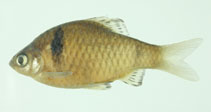
Taggstrålar i ryggfenan (totalt) : 0; Mjukstrålar i ryggfenan (totalt) : 11 - 12; Taggstrålar i analfenan: 0; Mjukstrålar i analfenan: 8; Ryggkotor: 29 - 31. A member of the Puntius conchonius group and is most similar to P. cumingii, P. meingangbii and P. tiantian by having a dark vertical bar anteriorly on side and a dark round blotch on caudal peduncle. Differs from P. cumingii by 12 vs. 10 circumpeduncular scales and 3 1/2 vs. 4 1/2 scales above midline; from P. meingangbii by 40.4-48.2% SL vs. 33.3-39.6% SL body depth of adults; and from geographically close P. tiantian by having last unbranched dorsal fin ray thick and strongly serrated instead of slender, flexible and with short serrations posteriorly, body depth 40.4-48.2% SL vs. 35.4-39.8% SL, dorsal fin length 26.6-31.8% SL vs. 23.2-26.0% SL, lateral line limited to six to seven, rarely up to ten anterior scales, vs. continued to caudal fin base, and males with two series of black marks in dorsal fin and one series of black marks in anal fin, vs. a single dark bank in each fin in male P. tiantian. Distinguished form P. phutunio by wider infraorbitals 3+4, extending posteriorly to the margin of the preopercle instead of only halfway to the preopercle, 12 vs. 10 circumpeduncular scales, absence of a dark blotch anteriorly at the base of the dorsal fin, and absence of a dark bank extending obliquely rostrad and ventrad from immediately posterior to the dorsal fin base (Ref. 54351).
Body shape (shape guide): fusiform / normal.
Inhabits stream with fast flowing, clear, brownish water and with bottom consisted of mud mixed with stones (Ref. 54351).
Livscykel och parningsbeteende
Könsmognad | Reproduktion | Lek | Ägg | Fekunditet | Larver
Pethiyagoda, R., M. Meegaskumbura and K. Maduwage, 2012. A synopsis of the South Asian fishes referred to Puntius (Pisces: Cyprinidae). Ichthyol. Explor. Freshwat. 23(1):69-95. (Ref. 91036)
Status på IUCN:s rödlista (Ref. 130435: Version 2025-2 (Global))
Hot mot människor
Harmless
Mänskliga användningsområden
Verktyg
Särskilda rapporter
Ladda ner XML
Internet-källor
Uppskattningar baserade på modeller
Index för fylogenetisk mångfald (Ref.
82804): PD
50 = 0.5000 [Uniqueness, from 0.5 = low to 2.0 = high].
Bayesian length-weight: a=0.01047 (0.00454 - 0.02413), b=3.00 (2.83 - 3.17), in cm total length, based on LWR estimates for this Genus-body shape (Ref.
93245).
Trofisk nivå (Ref.
69278): 2.7 ±0.2 se; based on size and trophs of closest relatives
Resiliens (Ref.
120179): Hög, lägsta populationsfördubblingstid mindre än 15 månader (Preliminary K or Fecundity.).
Sårbarhet i fisket (Ref.
59153): Low vulnerability (10 of 100).
🛈