Klassifizierung / Names
Namen | Synonyme | Catalog of Fishes(Gattung, Arten) | ITIS | CoL | WoRMS | Cloffa
>
Gymnotiformes (Knifefishes) >
Gymnotidae (Naked-back knifefishes) > Gymnotinae
Etymology: Gymnotus: Greek, gymnos = naked (Ref. 45335); pantanal: The specific epithet pantanal from the Pantanal Matogrossense of Brazil, the hydrological region of the type locality. A noun in apposition.
Umwelt: Milieu / Klimazone / Tiefenbereich / Verbreitungsgebiet
Ökologie
; süßwasser demersal. Tropical
South America: Brazil, Paraguay and Bolivia.
Größe / Gewicht / Alter
Geschlechtsreife: Lm ? range ? - ? cm
Max length : 26.0 cm TL Männchen/unbestimmt; (Ref. 118108)
Kurzbeschreibung
Bestimmungsschlüssel | Morphologie | Morphometrie
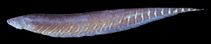
Gymnotus pantanal differs from other members of the G. pantherinus species-
group (except G. anguillaris) in possessing a color pattern composed of thin obliquely oriented pale pigment bands (about one third the width of the dark bands) with wavy margins restricted to the ventral portion of the body (rarely extending above the lateral line) on
the anterior half of the body. Gymnotus pantanal further differs from other members of the G. pantherinus species-group in possessing a wider head (72–77 vs. 52–69% head length). Gymnotus pantanal further differs from G. anguillaris in possessing more narrowly set eyes (37–41 vs. 43–56% head length), a deeper head (66–74 vs. 60–65% head length), larger branchial openings (38–43 vs. 29–36% head length), longer pectoral fins (51–56 vs.
42–50% head length), more pectoral-fin rays (mode 17 vs. 16), and fewer pored posterior
lateral-line scales (to first ventral ramus: 47–58 vs. 58–62; total: 102–114 vs. 124–130).
Body shape (shape guide): elongated.
Facultative air-breathing in the genus (Ref. 126274); Found in rooted grasses and floating macrophytes in small creeks and along the banks of larger backwater rivers (Ref. 54472). Occurs syntopically with Gymnotus inaequilabiatus and G. sylvius (Ref. 54472).
Lebenszyklus und Paarungsverhalten
Geschlechtsreife | Fortpflanzung | Ablaichen | Eier | Fruchtbarkeit | Larven
Fernandes, F.M.C., J.S. Albert, M.F.Z. Daniel-Silva, C.E. Lopes, W.G.R. Crampton and L.F. Almeida-Toledo, 2005. A new Gymnotus (Teleostei: Gymnotiformes: Gymnotidae) from the Pantanal Matogrossense of Brazil and adjacent drainages: continued documention of a cryptic fauna. Zootaxa 933:1-14. (Ref. 54472)
IUCN Rote Liste Status (Ref. 130435: Version 2025-2 (Global))
Bedrohung für Menschen
Harmless
Nutzung durch Menschen
Tools
Zusatzinformationen
Download XML
Internet Quellen
Schätzungen auf der Grundlage von Modellen
Phylogenetischer Diversitätsindex (Ref.
82804): PD
50 = 0.5000 [Uniqueness, from 0.5 = low to 2.0 = high].
Bayesian length-weight: a=0.00437 (0.00209 - 0.00911), b=2.98 (2.79 - 3.17), in cm total length, based on LWR estimates for this (Sub)family-body shape (Ref.
93245).
Trophische Ebene (Ref.
69278): 3.3 ±0.4 se; based on size and trophs of closest relatives
Widerstandsfähigkeit (Ref.
120179): hoch, Verdopplung der Population dauert weniger als 15 Monate. (Preliminary K or Fecundity.).
Anfälligkeit der Fischerei (Ref.
59153): Low vulnerability (16 of 100).
🛈