Clasificación / Nombres
Nombres comunes | Sinónimos | Catalog of Fishes(Género, Especie) | ITIS | CoL | WoRMS | Cloffa
>
Gymnotiformes (Knifefishes) >
Gymnotidae (Naked-back knifefishes) > Gymnotinae
Etymology: Gymnotus: Greek, gymnos = naked (Ref. 45335); pantanal: The specific epithet pantanal from the Pantanal Matogrossense of Brazil, the hydrological region of the type locality. A noun in apposition.
Entorno: milieu / zona climática / rango de profundidad / gama de distribución
Ecología
; agua dulce demersal. Tropical
South America: Brazil, Paraguay and Bolivia.
Tamaño / Peso / Edad
Madurez: Lm ? range ? - ? cm
Max length : 26.0 cm TL macho / no sexado; (Ref. 118108)
Descripción breve
Claves de identificación | Morfología | Morfometría
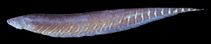
Gymnotus pantanal differs from other members of the G. pantherinus species-
group (except G. anguillaris) in possessing a color pattern composed of thin obliquely oriented pale pigment bands (about one third the width of the dark bands) with wavy margins restricted to the ventral portion of the body (rarely extending above the lateral line) on
the anterior half of the body. Gymnotus pantanal further differs from other members of the G. pantherinus species-group in possessing a wider head (72–77 vs. 52–69% head length). Gymnotus pantanal further differs from G. anguillaris in possessing more narrowly set eyes (37–41 vs. 43–56% head length), a deeper head (66–74 vs. 60–65% head length), larger branchial openings (38–43 vs. 29–36% head length), longer pectoral fins (51–56 vs.
42–50% head length), more pectoral-fin rays (mode 17 vs. 16), and fewer pored posterior
lateral-line scales (to first ventral ramus: 47–58 vs. 58–62; total: 102–114 vs. 124–130).
Body shape (shape guide): elongated.
Facultative air-breathing in the genus (Ref. 126274); Found in rooted grasses and floating macrophytes in small creeks and along the banks of larger backwater rivers (Ref. 54472). Occurs syntopically with Gymnotus inaequilabiatus and G. sylvius (Ref. 54472).
Ciclo vital y comportamiento de apareamiento
Madurez | Reproducción | Puesta | Huevos | Fecundidad | Larva
Fernandes, F.M.C., J.S. Albert, M.F.Z. Daniel-Silva, C.E. Lopes, W.G.R. Crampton and L.F. Almeida-Toledo, 2005. A new Gymnotus (Teleostei: Gymnotiformes: Gymnotidae) from the Pantanal Matogrossense of Brazil and adjacent drainages: continued documention of a cryptic fauna. Zootaxa 933:1-14. (Ref. 54472)
Situación en la Lista Roja de la UICN (Ref. 130435: Version 2025-2 (Global))
Amenaza para el ser humano
Harmless
Usos humanos
Herramientas
Informes especiales
Descargar XML
Fuentes de Internet
Estimaciones basadas en modelos
Índice de diversidad filogenética (Referencia
82804): PD
50 = 0.5000 [Uniqueness, from 0.5 = low to 2.0 = high].
Bayesian length-weight: a=0.00437 (0.00209 - 0.00911), b=2.98 (2.79 - 3.17), in cm total length, based on LWR estimates for this (Sub)family-body shape (Ref.
93245).
Nivel trófico (Referencia
69278): 3.3 ±0.4 se; based on size and trophs of closest relatives
Resiliencia (Referencia
120179): Alto, población duplicada en un tiempo mínimo inferior a 15 meses (Preliminary K or Fecundity.).
Vulnerabilidad pesquera (Ref.
59153): Low vulnerability (16 of 100).
🛈