Elasmobranchi (squali e razze) (sharks and rays) >
Myliobatiformes (Stingrays) >
Dasyatidae (Stingrays) > Urogymninae
Etymology: Pateobatis: Combination of Latin 'pateo' for 'lie open, be exposed' and 'batis' for skate, ray or flatfish; referring to the eclectic nature of members of this group; hortlei: Named for Kent Hortle.
Eponymy: Kent Gregory Hortle is an Australian fisheries and environmental consultant whose bachelor’s degree in zoology was awarded by Monash University, Melbourne (1979). [...] (Ref. 128868), visit book page.
More on authors: Last, Manjaji-Matsumoto & Kailola.
Ambiente: milieu / zona climatica / distribuzione batimetrica / gamma di distribuzione
Ecologia
marino; salmastro demersale; distribuzione batimetrica 2 - 7 m (Ref. 58025). Tropical
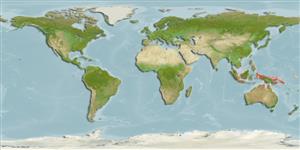
Western Pacific: eastern Indonesia (Irian Jaya), Papua New Guinea and northern Australia.
Dimensione / Peso / Età
Maturità: Lm ? range ? - ? cm
Max length : 70.7 cm WD maschio/sesso non determinato; (Ref. 58025); 65.4 cm WD (female)
Breve descrizione
Chiavi di identificazione | Morfologia | Morfometria
Distinguished by the following combination of characters: subcircular disc, very angular anteriorly, length 1.1 times DW; pectoral-fin apices broadly rounded; snout extremely elongate, 11-18 times orbit diameter, 96-99° angle; snout to maximum disc width 52-58% of DW; orbit very small, diameter 0.4-0.5 of spiracle length, 3.8-6.3 times in interorbital distance; mouth not greatly protrusible; prepelvic process not expanded; 1-3 enlarged, flattened, pearl-shaped mid-scapular denticles; denticles of main band in two main sizes in adults, crowns plate-like to heart-shaped; dorsal disc uniformly yellowish, brownish, or greyish; ventral surface of adults usually canary yellow in fresh material, often black around oronasal region and gill slits; pectoral fin radials 135-143; pelvic-fin radials 22-28; total vertebral centra 99-108 (Ref. 58025).
Body shape (shape guide): other.
Demersal inshore; commonly found over shallow intertidal mud flats and in estuaries in only several metres depth. Viviparous, with histotrophy. Presumably feeds on crustaceans, molluscs and small fishes. Caught regularly, but usually avoided, by beach seine fisheries operating in intertidal habitats. Possibly adversely affected by mangrove loss. Utilized for its meat, and possibly also for its skin and cartilage. (Ref.58048).
Ciclo vitale e comportamento di accoppiamento
Maturità | Riproduzione | Deposizione | Uova | Fecondità | Larve
Last, P.R., M. Manjaji-Matsumoto and P.J. Kailola, 2006. Himantura hortlei n. sp., a new species of whipray (Myliobatiformes: Dasyatidae) from Irian Jaya, Indonesia. Zootaxa 1239:19-34. (Ref. 58025)
Stato della Lista Rossa IUCN (Ref. 130435: Version 2025-2 (Global))
Minaccia per l'uomo
Harmless
Usi umani
Strumenti
Rapporti speciali
Scarica XML
Fonti Internet
Stime basate su modelli
Temperatura preferita (Fonte Biblio.
123201): 27.9 - 29.2, mean 28.8 °C (based on 264 cells).
Indice di diversità filogenetica (Fonte Biblio.
82804): PD
50 = 0.5312 [Uniqueness, from 0.5 = low to 2.0 = high].
Bayesian length-weight: a=0.01023 (0.00482 - 0.02174), b=3.06 (2.86 - 3.26), in cm total length, based on LWR estimates for this (Sub)family-body shape (Ref.
93245).
Livello trofico (Fonte Biblio.
69278): 3.5 ±0.5 se; based on size and trophs of closest relatives
Vulnerabilità della pesca (Ref.
59153): Very high vulnerability (90 of 100).
🛈