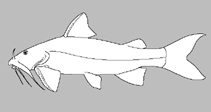
klasifikasi / Nama
Nama-nama umum | Sinonim (persamaan) | Catalog of Fishes(Marga, Jenis) | ITIS | CoL | WoRMS | Cloffa
>
Siluriformes (Catfishes) >
Sisoridae (Sisorid catfishes) > Sisorinae
Etymology: ferula: From the Latin ferula, meaning rod, in reference to the terete head and body of this species, which is considerably narrower than its congeners.
Lingkungan: lingkungan / zona iklim / kisaran kedalaman / jangkauan distribusi
Ekologi
; air tawar dasar (demersal). Tropical
Asia: Tista River in West Bengal, India.
Ukuran / Berat / umur
Kematangan: Lm ? range ? - ? cm
Max length : 2.5 cm SL jantan/; (Ref. 58769)
deskripsi pendek
Kunci identifiaksi (pengenalan) | Morfologi | Morfometrik
duri punggung lunak (Keseluruhan (total)) : 5; Sirip dubur lunak: 9; vertebrata, bertulang belakang: 28 - 30. Distinguished from its congeners in having a terete head and body (vs. slightly depressed body and strongly depressed head), which is easily manifested in the head width (17.1-19.1% SL vs. 19.4-24.3). Differs also from congeners in having a smaller anterior fontanel (about one third the length of the frontals vs. at least half the length), and very faint, poorly contrasting cream bands that are sometimes not present on some individuals (vs. sharp contrasting cream band on body). Differs further from other species of the genus, except Pseudolaguvia ribeiroi, in having a shorter adipose-fin base (11.5-13.0% SL vs. 14.8-24.0), and, except Pseudolaguvia foveolata, in having the unculiferous ridges on the thoracic adhesive apparatus joined at their posterior ends (vs. separate). Differs further from Pseudolaguvia foveolata in having fewer vertebrae (28-30 vs. 33) and a longer thoracic adhesive apparatus, extending to midway between bases of last pectoral-fin ray and first pelvic-fin ray (vs. to middle of pectoral-fin base), from Pseudolaguvia inormata in having a slender body (12.1-13.8% SL vs. 13.9-16.1) and smaller eye (8.6-11.7% HL vs. 12.7-14.9), from P. kapuri in having shorter pelvic fin (not reaching base of the first anal-fin ray vs. reaching; 13.0-14.7% SL vs. 15.3-17.9), and from Pseudolaguvia muricata in having shorter dorsal and pectoral spines (17.3-18.7% SL vs. 21.2-26.7 and 20.2-24.3% SL vs. 26.8-35.7 respectively) and a smaller eye (8.6-11.7% HL vs. 11.4-15.1). Can be distinguished further from Pseudolaguvia ribeiroi in having less distinct mesethmoid cornua, from Pseudolaguvia shawi in having a longer dorsal spine (17.3-18.7% SL vs. 13.4-16.7), and from Pseudolaguvia tenebricosa and Pseudolaguvia tuberculata in having a more slender caudal peduncle (6.9-7.8% SL vs. 7.6-9.0) (Ref. 58769).
Occurs in swift flowing river with mixed rocky/sandy bottom (Ref. 58769).
Siklus hidup dan perilaku kawin
Kematangan | Reproduksi, perkembang biakan | Pemijahan | telur-telur | Fekunditas | Larva
Ng, H.H., 2006. Pseudolaguvia ferula, a new species of sisoroid catfish (Teleostei: Erethistidae) from India. Zootaxa 1229:59-68. (Ref. 58769)
Status IUCN Red List (Ref. 130435: Version 2025-2 (Global))
ancaman kepada manusia
Harmless
penggunaan manusia
Alat, peralatan
laporan khas
muat turun XML
Sumber internet
Estimasi berdasarkan model
Indeks keanekaragaman filogenetik (Acuan
82804): PD
50 = 0.5000 [Uniqueness, from 0.5 = low to 2.0 = high].
Bayesian length-weight: a=0.00676 (0.00310 - 0.01476), b=3.03 (2.85 - 3.21), in cm total length, based on LWR estimates for this (Sub)family-body shape (Ref.
93245).
Tingkat Trofik (Acuan
69278): 3.1 ±0.4 se; based on size and trophs of closest relatives
Kerentanan Penangkapan Ikan (Ref.
59153): Low vulnerability (10 of 100).
🛈