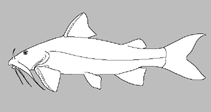
Classification / Noms
Noms communs | Synonymes | Catalog of Fishes(Genre, Espèce) | ITIS | CoL | WoRMS | Cloffa
>
Siluriformes (Catfishes) >
Sisoridae (Sisorid catfishes) > Sisorinae
Etymology: ferula: From the Latin ferula, meaning rod, in reference to the terete head and body of this species, which is considerably narrower than its congeners.
Environnement : milieu / zone climatique / profondeur / gamme de distribution
Écologie
; eau douce démersal. Tropical
Asia: Tista River in West Bengal, India.
Taille / Poids / Âge
Maturité: Lm ? range ? - ? cm
Max length : 2.5 cm SL mâle / non sexé; (Ref. 58769)
Description synthétique
Clés d'identification | Morphologie | Morphométrie
Rayons mous dorsaux (Total) : 5; Rayons mous anaux: 9; Vertèbres: 28 - 30. Distinguished from its congeners in having a terete head and body (vs. slightly depressed body and strongly depressed head), which is easily manifested in the head width (17.1-19.1% SL vs. 19.4-24.3). Differs also from congeners in having a smaller anterior fontanel (about one third the length of the frontals vs. at least half the length), and very faint, poorly contrasting cream bands that are sometimes not present on some individuals (vs. sharp contrasting cream band on body). Differs further from other species of the genus, except Pseudolaguvia ribeiroi, in having a shorter adipose-fin base (11.5-13.0% SL vs. 14.8-24.0), and, except Pseudolaguvia foveolata, in having the unculiferous ridges on the thoracic adhesive apparatus joined at their posterior ends (vs. separate). Differs further from Pseudolaguvia foveolata in having fewer vertebrae (28-30 vs. 33) and a longer thoracic adhesive apparatus, extending to midway between bases of last pectoral-fin ray and first pelvic-fin ray (vs. to middle of pectoral-fin base), from Pseudolaguvia inormata in having a slender body (12.1-13.8% SL vs. 13.9-16.1) and smaller eye (8.6-11.7% HL vs. 12.7-14.9), from P. kapuri in having shorter pelvic fin (not reaching base of the first anal-fin ray vs. reaching; 13.0-14.7% SL vs. 15.3-17.9), and from Pseudolaguvia muricata in having shorter dorsal and pectoral spines (17.3-18.7% SL vs. 21.2-26.7 and 20.2-24.3% SL vs. 26.8-35.7 respectively) and a smaller eye (8.6-11.7% HL vs. 11.4-15.1). Can be distinguished further from Pseudolaguvia ribeiroi in having less distinct mesethmoid cornua, from Pseudolaguvia shawi in having a longer dorsal spine (17.3-18.7% SL vs. 13.4-16.7), and from Pseudolaguvia tenebricosa and Pseudolaguvia tuberculata in having a more slender caudal peduncle (6.9-7.8% SL vs. 7.6-9.0) (Ref. 58769).
Occurs in swift flowing river with mixed rocky/sandy bottom (Ref. 58769).
Cycle de vie et comportement reproducteur
Maturité | Reproduction | Frai | Œufs | Fécondité | Larves
Ng, H.H., 2006. Pseudolaguvia ferula, a new species of sisoroid catfish (Teleostei: Erethistidae) from India. Zootaxa 1229:59-68. (Ref. 58769)
Statut dans la liste rouge de l'IUCN (Ref. 130435: Version 2025-2 (Global))
Menace pour l'homme
Harmless
Utilisations par l'homme
Outils
Articles particuliers
Télécharger en XML
Sources Internet
Estimations basées sur des modèles
Indice de diversité phylogénétique (Réf.
82804): PD
50 = 0.5000 [Uniqueness, from 0.5 = low to 2.0 = high].
Bayesian length-weight: a=0.00676 (0.00310 - 0.01476), b=3.03 (2.85 - 3.21), in cm total length, based on LWR estimates for this (Sub)family-body shape (Ref.
93245).
Niveau trophique (Réf.
69278): 3.1 ±0.4 se; based on size and trophs of closest relatives
Vulnérabilité de la pêche (Ref.
59153): Low vulnerability (10 of 100).
🛈