Ambiente: milieu / zona climatica / distribuzione batimetrica / gamma di distribuzione
Ecologia
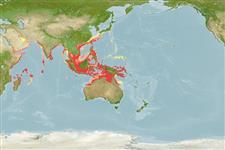
marino; salmastro associati a barriera corallina; amfidromo (Ref. 51243); distribuzione batimetrica 0 - 120 m (Ref. 30573). Tropical; 35°N - 20°S, 40°E - 156°E (Ref. 55462)
Indo-Pacific: probably throughout the warmer coastal waters, from the Red Sea and East Africa to the Solomon Islands, north to southern Japan, south to northern Australia. Recently reported from Tonga (Ref. 53797).
Dimensione / Peso / Età
Maturità: Lm ? range ? - ? cm
Max length : 100.0 cm SL maschio/sesso non determinato; (Ref. 188); 36.6 cm SL (female); common length : 60.0 cm TL maschio/sesso non determinato; (Ref. 5450)
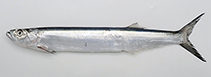
Spine dorsali (totale) : 0; Raggi dorsali molli (totale) : 16 - 19; Spine anali: 0; Raggi anali molli: 29 - 36. Diagnosis: The slightly shorter pectoral fin, 11-13% of standard length, and the black marking of the upper part of the dorsal fin are the only satisfactory characters separating this species from Chirocentrus nudus; there is also some black on the anterior part of the anal fin (Ref. 188).
Body shape (shape guide): elongated; Cross section: compressed.
Occurs inshore, including brackish waters (Ref. 12743), from the shore to a depth of about 120 m (Ref. 30573). In Australia, it was reported in water temperatures of 26.0-29.0 °C (Ref. 4959). It feeds mainly on small fish and crustaceans (Ref. 188, 30573). Voracious predators of small schooling fishes, e.g. herrings and anchovies (Ref. 37816). Marketed fresh, frozen or dried and salted.
Ciclo vitale e comportamento di accoppiamento
Maturità | Riproduzione | Deposizione | Uova | Fecondità | Larve
Whitehead, P.J.P., 1985. FAO Species Catalogue. Vol. 7. Clupeoid fishes of the world (suborder Clupeoidei). An annotated and illustrated catalogue of the herrings, sardines, pilchards, sprats, shads, anchovies and wolf-herrings. FAO Fish. Synop. 125(7/1):1-303. Rome: FAO. (Ref. 188)
Stato della Lista Rossa IUCN (Ref. 130435: Version 2025-2 (Global))
Minaccia per l'uomo
Harmless
Usi umani
Pesca: commerciale; Pesce da pesca sportiva: si; esca: usually
Strumenti
Rapporti speciali
Scarica XML
Fonti Internet
Stime basate su modelli
Temperatura preferita (Fonte Biblio.
123201): 25.5 - 29.1, mean 28.1 °C (based on 1980 cells).
Indice di diversità filogenetica (Fonte Biblio.
82804): PD
50 = 1.0000 [Uniqueness, from 0.5 = low to 2.0 = high].
Bayesian length-weight: a=0.00513 (0.00359 - 0.00733), b=2.96 (2.86 - 3.06), in cm total length, based on LWR estimates for this species (Ref.
93245).
Livello trofico (Fonte Biblio.
69278): 4.4 ±0.89 se; based on food items.
Resilienza (Fonte Biblio.
120179): Medio, tempo minimo di raddoppiamento della popolazione 1.4 - 4.4 anni (Assuming tm=2).
Prior r = 0.54, 95% CL = 0.36 - 0.81, Based on 9 data-limited stock assessments.
Vulnerabilità della pesca (Ref.
59153): High to very high vulnerability (73 of 100).
🛈
Vulnerabilità climatica (Ref.
125649): High to very high vulnerability (75 of 100).
🛈
Nutrienti (Ref.
124155): Calcium = 24.9 [13.8, 49.1] mg/100g; Iron = 0.471 [0.261, 0.831] mg/100g; Protein = 20.3 [17.7, 22.5] %; Omega3 = 0.138 [0.072, 0.264] g/100g; Selenium = 51.3 [26.6, 110.1] μg/100g; VitaminA = 67.5 [19.3, 202.7] μg/100g; Zinc = 0.827 [0.566, 1.249] mg/100g (wet weight); based on
nutrient studies.