>
Ovalentaria/misc (Various families in series Ovalentaria) >
Pseudochromidae (Dottybacks) > Pseudochrominae
Etymology: Pictichromis: Name from Latin pictus meaning painted or colored, and Greek Chromis, a genus of pomacentrid, used as the stem for other fish genera; alludes to the bright live colorations of the included species (Ref. 81967); caitlinae: Named for Ms. Caitlin Elizabeth Samuel.
Eponymy: Ms. Caitlin Elizabeth Samuel (d: 1993) is the daughter of a supporter of a conservation initiative. The etymology says: “The new species is named caitlinae for Ms. Caitlin Elizabeth Samuel, a young Canadian leader, on the occasion of her sixteenth [...] (Ref. 128868), visit book page.
More on authors: Allen, Gill & Erdmann.
Lingkungan: lingkungan / zona iklim / kisaran kedalaman / jangkauan distribusi
Ekologi
laut berasosiasi dengan karang; kisaran kedalaman 10 - 55 m (Ref. 74963). Tropical
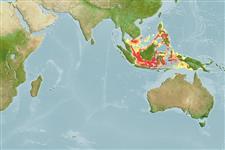
Western Pacific: Apparently restricted to Cenderawasih Bay, Indonesia.
Ukuran / Berat / umur
Kematangan: Lm ? range ? - ? cm
Max length : 4.3 cm SL jantan/; (Ref. 74963)
deskripsi pendek
Kunci identifiaksi (pengenalan) | Morfologi | Morfometrik
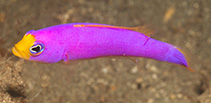
Duri punggung (Keseluruhan (total)) : 3; duri punggung lunak (Keseluruhan (total)) : 22; Duri dubur: 3; Sirip dubur lunak: 11 - 12. This species is distinguished from its congeners by having a bright yellow-orange snout/forehead, and a strongly contrasted magenta coloration over the remainder of the head and body. The species Pictichromis aurifrons has a similar yellow colour pattern, but with the remainder of the head and body being light purple to bluish grey, rather than magenta, and the gradation between the two contrasting colours is relatively gradual rather than abrupt (Ref. 74963).
Body shape (shape guide): elongated; Cross section: compressed.
Common in the inner portion of the bay, observed at 16 of 27 inner bay sites during the 2006 survey. This species is replaced by P. porphyrea (Lubbock & Goldman, 1974) in the outer portion of the bay (e.g. vicinity of Biak) . It occurs on relatively silty, turbid reefs at depths
between about 10 and 55 m, generally around rocky outcrops (Ref. 74963).
Siklus hidup dan perilaku kawin
Kematangan | Reproduksi, perkembang biakan | Pemijahan | telur-telur | Fekunditas | Larva
Allen, G.R., A.C. Gill and M.V. Erdmann, 2008. A new species of Pictichromis (Pisces: Pseudochromidae) from western New Guinea with a rediscription of P. aurifrons,. aqua, Int. J. Ichthyol. 13(3-4):145-154. (Ref. 74963)
Status IUCN Red List (Ref. 130435: Version 2025-2 (Global))
ancaman kepada manusia
Harmless
penggunaan manusia
Alat, peralatan
laporan khas
muat turun XML
Sumber internet
Estimasi berdasarkan model
Suhu yang disukai (Acuan
123201): 27.8 - 29.1, mean 28.5 °C (based on 20 cells).
Indeks keanekaragaman filogenetik (Acuan
82804): PD
50 = 0.5039 [Uniqueness, from 0.5 = low to 2.0 = high].
Bayesian length-weight: a=0.00501 (0.00191 - 0.01317), b=3.10 (2.88 - 3.32), in cm total length, based on LWR estimates for this (Sub)family-body shape (Ref.
93245).
Tingkat Trofik (Acuan
69278): 3.4 ±0.5 se; based on size and trophs of closest relatives
Kerentanan Penangkapan Ikan (Ref.
59153): Low vulnerability (10 of 100).
🛈