>
Ovalentaria/misc (Various families in series Ovalentaria) >
Pseudochromidae (Dottybacks) > Pseudochrominae
Etymology: Pictichromis: Name from Latin pictus meaning painted or colored, and Greek Chromis, a genus of pomacentrid, used as the stem for other fish genera; alludes to the bright live colorations of the included species (Ref. 81967); caitlinae: Named for Ms. Caitlin Elizabeth Samuel.
Eponymy: Ms. Caitlin Elizabeth Samuel (d: 1993) is the daughter of a supporter of a conservation initiative. The etymology says: “The new species is named caitlinae for Ms. Caitlin Elizabeth Samuel, a young Canadian leader, on the occasion of her sixteenth [...] (Ref. 128868), visit book page.
More on authors: Allen, Gill & Erdmann.
Environnement : milieu / zone climatique / profondeur / gamme de distribution
Écologie
marin récifal; profondeur 10 - 55 m (Ref. 74963). Tropical
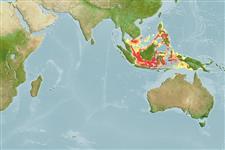
Western Pacific: Apparently restricted to Cenderawasih Bay, Indonesia.
Taille / Poids / Âge
Maturité: Lm ? range ? - ? cm
Max length : 4.3 cm SL mâle / non sexé; (Ref. 74963)
Description synthétique
Clés d'identification | Morphologie | Morphométrie
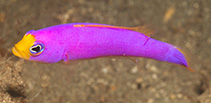
Épines dorsales (Total) : 3; Rayons mous dorsaux (Total) : 22; Épines anales: 3; Rayons mous anaux: 11 - 12. This species is distinguished from its congeners by having a bright yellow-orange snout/forehead, and a strongly contrasted magenta coloration over the remainder of the head and body. The species Pictichromis aurifrons has a similar yellow colour pattern, but with the remainder of the head and body being light purple to bluish grey, rather than magenta, and the gradation between the two contrasting colours is relatively gradual rather than abrupt (Ref. 74963).
Body shape (shape guide): elongated; Cross section: compressed.
Common in the inner portion of the bay, observed at 16 of 27 inner bay sites during the 2006 survey. This species is replaced by P. porphyrea (Lubbock & Goldman, 1974) in the outer portion of the bay (e.g. vicinity of Biak) . It occurs on relatively silty, turbid reefs at depths
between about 10 and 55 m, generally around rocky outcrops (Ref. 74963).
Cycle de vie et comportement reproducteur
Maturité | Reproduction | Frai | Œufs | Fécondité | Larves
Allen, G.R., A.C. Gill and M.V. Erdmann, 2008. A new species of Pictichromis (Pisces: Pseudochromidae) from western New Guinea with a rediscription of P. aurifrons,. aqua, Int. J. Ichthyol. 13(3-4):145-154. (Ref. 74963)
Statut dans la liste rouge de l'IUCN (Ref. 130435: Version 2025-2 (Global))
Menace pour l'homme
Harmless
Utilisations par l'homme
Outils
Articles particuliers
Télécharger en XML
Sources Internet
Estimations basées sur des modèles
Température préférée (Réf.
123201): 27.8 - 29.1, mean 28.5 °C (based on 20 cells).
Indice de diversité phylogénétique (Réf.
82804): PD
50 = 0.5039 [Uniqueness, from 0.5 = low to 2.0 = high].
Bayesian length-weight: a=0.00501 (0.00191 - 0.01317), b=3.10 (2.88 - 3.32), in cm total length, based on LWR estimates for this (Sub)family-body shape (Ref.
93245).
Niveau trophique (Réf.
69278): 3.4 ±0.5 se; based on size and trophs of closest relatives
Vulnérabilité de la pêche (Ref.
59153): Low vulnerability (10 of 100).
🛈