Taxonomic Remarks
Genus Hypodytes, according to Paxton et al. 1989 (Ref. 7300).
Entorno: milieu / zona climática / rango de profundidad / gama de distribución
Ecología
marino demersal; rango de profundidad 14 - 60 m (Ref. 30573), usually 15 - 50 m (Ref. 4313). Deep-water
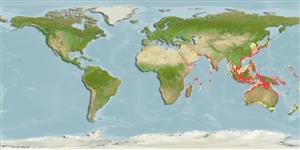
Indo-West Pacific: Red Sea and the Persian Gulf south to Natal, South Africa and east to India and the Philippines, north to China and Japan, south Australia.
Tamaño / Peso / Edad
Madurez: Lm ? range ? - ? cm
Max length : 20.0 cm TL macho / no sexado; (Ref. 48635); common length : 10.0 cm TL macho / no sexado; (Ref. 3503)
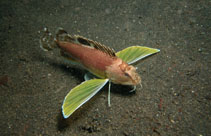
Espinas dorsales (total) : 14 - 16; Radios blandos dorsales (total) : 8 - 10; Espinas anales: 3 - 4; Radios blandos anales: 6 - 8. Bluish grey in color, belly pale; large black spot on rear half of spinous dorsal (Ref. 4313).
Body shape (shape guide): fusiform / normal.
Inhabits soft bottoms of the continental shelf. Primarily known from trawls over prawn-grounds but divers looking in suitable habitats can come across them, especially at night. During the day it buries itself deep in the sand with just the eyes exposed. When disturbed, it spreads its long pectoral fins with the bright upper color to deter predators. It uses its fins to corner prey and has sensitive barbels below the mouth to detect those buried in the substrate (Ref. 48635). Fin spines venomous (anterolateral glandular groove with venom gland (Ref. 57406)) (Ref. 30573). Sold in small quantities either fresh or dried and salted in markets. Minimum depth reported taken from Ref. 57178.
Ciclo vital y comportamiento de apareamiento
Madurez | Reproducción | Puesta | Huevos | Fecundidad | Larva
Matsunuma, M., Y.G. Seah and H. Motomura, 2024. Review of Apistus (Synanceiidae: Apistinae) with description of a new species from the Arabian Sea and taxonomic status of Apistus balnearum Ogilby 1910, a junior synonym of Apistops caloundra (De Vis 1886). Ichthyol. Res. 72(3):320-349. (Ref. 137862)
Situación en la Lista Roja de la UICN (Ref. 130435: Version 2025-2 (Global))
Amenaza para el ser humano
Usos humanos
Pesquerías: escaso valor comercial
Herramientas
Informes especiales
Descargar XML
Fuentes de Internet
Estimaciones basadas en modelos
Temperatura preferida (Referencia
123201): 23.3 - 29, mean 28 °C (based on 1680 cells).
Índice de diversidad filogenética (Referencia
82804): PD
50 = 0.8125 [Uniqueness, from 0.5 = low to 2.0 = high].
Bayesian length-weight: a=0.01175 (0.00443 - 0.03114), b=3.02 (2.80 - 3.24), in cm total length, based on LWR estimates for this (Sub)family-body shape (Ref.
93245).
Nivel trófico (Referencia
69278): 3.6 ±0.4 se; based on size and trophs of closest relatives
Vulnerabilidad pesquera (Ref.
59153): Low vulnerability (10 of 100).
🛈