Классификация / Имена
народные названия | синонимы | Catalog of Fishes(род, виды) | ITIS | CoL | WoRMS | Cloffa
>
Siluriformes (Catfishes) >
Loricariidae (Armored catfishes) > Hypoptopomatinae
Etymology: Curculionichthys: Derived from the from the Latin 'curculionem' (elongated snout) and from the Greek 'ichthys' (fishes), in reference to the relatively elongated snouts of the fish species included in this genus; luteofrenatus: From the Latin luteo (yellow), and frenatus (with bridle), in reference to the yellow pair of lines running dorsally on head from tip of snout to dorsal rim of orbit (Ref. 75061).
Окружающая среда: среда / климатическая зона / пределы глубины / диапазон распространения
экология
; пресноводный демерсальный. Tropical
South America: Upper Rio Tapajós basin in Brazil.
Размер / Вес / Возраст
половая зрелость: Lm ? range ? - ? cm
Max length : 3.1 cm SL самец/пол неопределен; (Ref. 75061)
Краткое описание
определительные ключи | морфология | морфометрия
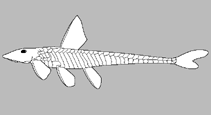
членистые (мягкие) лучи спинного плавника (общее число) : 8; членистые (мягкие) лучи анального плавника: 6. Diagnosed from all congeners, except Hisonotus insperatus, by having a pair of rostral plates at tip of snout. Distinguished from Hisonotus insperatus by having more teeth on premaxillary (12-30) and dentary bones (9-26) vs. (3-14) and (5-11). Can be differentiated from other species of the genus by the following combination of characters: longitudinal series with 25-26 plates; lateral line almost complete with 23-24 perforated plus last non-perforated plates; abdomen in adults entirely covered with large plates, five to eight plates in lateral series between tip of cleithrum and base of pelvic fin; large dark brown lateral stripe extending from tip of snout to caudal blotch; dorsum with basal dark blotch near origin of dorsal-fin region and three transverse dark brown bars located at end of dorsal-fin base, middle and end of caudal peduncle; yellow line extending from anterior part of each orbit, over inferior nostrils, both converging to tip of snout (Ref. 75061).
Body shape (shape guide): elongated.
Found in flat areas in creeks of headwaters of the Rio Tapajós in places of shallow clear waters with low current and sandy substrate, where the marginal vegetation is represented mainly by grass in deforested areas (Ref. 75061).
Жизненный цикл и брачное поведение
половая зрелость | размножение | нерест | икра | Плодовитость | личинки
Britski, H.A. and J.C. Garavello, 2007. Description of two new sympatric species of the genus Hisonotus Eigenmann and Eigenmann, 1889, from upper Rio Tapajós, Mato Grosso state, Brazil (Pisces: Ostariophysi: Loricariidae). Brazilian Journal of Biology 67(3):413-420. (Ref. 75061)
Статус Красного Списка МСОП (Ref. 130435: Version 2025-2 (Global))
Угроза для людей
Harmless
Использование человеком
рыболовство: интереса не представляет
дополнительная информация
инструменты
Специальные отчеты
Скачать в формате XML
ресурсы в Интернет
Оценки, основанные на моделях
Индекс филогенетического разнообразия (ссылка
82804): PD
50 = 0.5001 [Uniqueness, from 0.5 = low to 2.0 = high].
Bayesian length-weight: a=0.00977 (0.00434 - 0.02202), b=3.06 (2.87 - 3.25), in cm total length, based on LWR estimates for this (Sub)family-body shape (Ref.
93245).
Трофический уровень (ссылка
69278): 2.4 ±0.1 se; based on size and trophs of closest relatives
Уязвимость рыбной ловли (Ref.
59153): Low vulnerability (10 of 100).
🛈