>
Siluriformes (Catfishes) >
Loricariidae (Armored catfishes) > Hypoptopomatinae
Etymology: Curculionichthys: Derived from the from the Latin 'curculionem' (elongated snout) and from the Greek 'ichthys' (fishes), in reference to the relatively elongated snouts of the fish species included in this genus; luteofrenatus: From the Latin luteo (yellow), and frenatus (with bridle), in reference to the yellow pair of lines running dorsally on head from tip of snout to dorsal rim of orbit (Ref. 75061).
Môi trường: môi trường / vùng khí hậu / Mức độ sâu / phạm vi phân phối
Sinh thái học
; nước ngọt gần đáy. Tropical
South America: Upper Rio Tapajós basin in Brazil.
Bộ gần gũi / Khối lượng (Trọng lượng) / Tuổi
Chín muồi sinh dục: Lm ? range ? - ? cm
Max length : 3.1 cm SL con đực/không giới tính; (Ref. 75061)
Mô tả ngắn gọn
Khóa để định loại | Hình thái học | Sinh trắc học
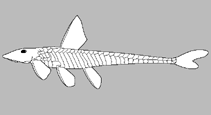
Các vây lưng mềm (tổng cộng) : 8; Tia mềm vây hậu môn: 6. Diagnosed from all congeners, except Hisonotus insperatus, by having a pair of rostral plates at tip of snout. Distinguished from Hisonotus insperatus by having more teeth on premaxillary (12-30) and dentary bones (9-26) vs. (3-14) and (5-11). Can be differentiated from other species of the genus by the following combination of characters: longitudinal series with 25-26 plates; lateral line almost complete with 23-24 perforated plus last non-perforated plates; abdomen in adults entirely covered with large plates, five to eight plates in lateral series between tip of cleithrum and base of pelvic fin; large dark brown lateral stripe extending from tip of snout to caudal blotch; dorsum with basal dark blotch near origin of dorsal-fin region and three transverse dark brown bars located at end of dorsal-fin base, middle and end of caudal peduncle; yellow line extending from anterior part of each orbit, over inferior nostrils, both converging to tip of snout (Ref. 75061).
Body shape (shape guide): elongated.
Found in flat areas in creeks of headwaters of the Rio Tapajós in places of shallow clear waters with low current and sandy substrate, where the marginal vegetation is represented mainly by grass in deforested areas (Ref. 75061).
Vòng đời và hành vi giao phối
Chín muồi sinh dục | Sự tái sinh sản | Đẻ trứng | Các trứng | Sự sinh sản | Ấu trùng
Britski, H.A. and J.C. Garavello, 2007. Description of two new sympatric species of the genus Hisonotus Eigenmann and Eigenmann, 1889, from upper Rio Tapajós, Mato Grosso state, Brazil (Pisces: Ostariophysi: Loricariidae). Brazilian Journal of Biology 67(3):413-420. (Ref. 75061)
Tình trạng Sách đỏ IUCN (Ref. 130435: Version 2025-2 (Global))
Mối đe dọa đối với con người
Harmless
Sử dụng của con người
Các nghề cá: không ích lợi (thú vị)
Các công cụ
Báo cáo đặc biệt
Tải xuống XML
Các nguồn internet
Ước tính dựa trên mô hình
Chỉ số đa dạng phát sinh loài (Tài liệu tham khảo
82804): PD
50 = 0.5001 [Uniqueness, from 0.5 = low to 2.0 = high].
Bayesian length-weight: a=0.00977 (0.00434 - 0.02202), b=3.06 (2.87 - 3.25), in cm total length, based on LWR estimates for this (Sub)family-body shape (Ref.
93245).
Mức dinh dưỡng (Tài liệu tham khảo
69278): 2.4 ±0.1 se; based on size and trophs of closest relatives
Sự dễ bị tổn thương của nghề đánh cá (Ref.
59153): Low vulnerability (10 of 100).
🛈