التصنيف / الأسماء
الأسماء الشائعة | مرادفات | Catalog of Fishes(جنس, الانواع) | ITIS | CoL | WoRMS | Cloffa
>
Siluriformes (Catfishes) >
Trichomycteridae (Pencil or parasitic catfishes) > Trichomycterinae
Etymology: Trichomycterus: Greek, thrix = hair + Greek, mykter, -eros = nose (Ref. 45335); crassicaudatus: Named from the Latin crassus (thick), cauda (tail), and atus (possess), in reference to the deep caudal peduncle.
البيئة: الوسط / المنطقة المناخية / نطاق العمق / نطاق التوزيع
البيئة
; المياه العذبة القاع; نطاق العمق 1 - 2 m (Ref. 75785). Tropical
South America: Rio Iguaçu basin in Brazil.
الحجم / وزن / العمر
النضج: Lm ? range ? - ? cm
Max length : 13.5 cm SL ذكر/ مختلط الجنس; (Ref. 75785)
وصف مختصر
مفاتيح التعريف | الوصف الخارجي | قياسات المظهر الخارجي
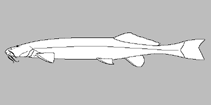
الأشعة الظهرية الناعمة (المجموع) : 12; أشعه شرجية لينه: 10; فقرات: 35 - 36. Diagnosed from all other species in the Trichomycteridae by the deep posterior region of the body, including the caudal peduncle and caudal fin (caudal-peduncle depth 22.8-25.4% SL in adults). Distinguished also from all members of the genus Trichomycterus by the shape of the caudal fin in adults, in which the fin is prolonged into long, markedly diverging and somewhat irregular lobes forming a concave posterior margin (vs. caudal fin either truncate, emarginate, or round). In addition, it can be separated from all other congeners and possibly all other trichomycterids by pronounced elongation of the neural and hemal spines of the caudal vertebrae along the mid-portion of the caudal peduncle. Differs further from all other trichomycterids, except Trichomycterus stawiarski, by having thick-ossified and rigid procurrent caudal-fin rays, markedly distinct from the flexible and splint-like procurrent rays in other trichomycterids. The coloration pattern consists of closely set large irregular blotches overlain by a more superficial layer of small round markings, which distinguishes this species from the majority of other species currently in Trichomycterus, except Trichomycterus stawiarski. Additional characters useful for recognizing this species which could not be checked in all species of Trichomycteridae include urohyal foramen reduced to a slender canal and lateral line with 5-7 pores (Ref. 75785).
Body shape (shape guide): elongated.
Found in a river with substrate composed of angular basaltic rocks and pebble. Collected also in a sector of the river with strong current and 1.2 m depth (Ref. 75785).
دورة الحياة وسلوك التزاوج
النضج | التكاثر | وضع البيض | بيض | الخصوبة | اليرقات
Wosiacki, W.B. and M. de Pinna, 2008. A new species of the neotropical catfish genus Trichomycterus (Siluriformes: Trichomycteridae) representing a new body shape for the family. Copeia 2008(2):273-278. (Ref. 75785)
حالة القائمة الحمراء للاتحاد الدولي لحفظ الطبيعة والموارد الطبيعية (Ref. 130435: Version 2025-2 (Global))
استخدامات بشرية
أدوات
تقارير خاصة
تنزيل XML
مصادر علي الأنترنت
تقديرات تستند إلى النماذج
مؤشر التنوع الشُعبي الوراثي (مرجع
82804): PD
50 = 0.5000 [Uniqueness, from 0.5 = low to 2.0 = high].
Bayesian length-weight: a=0.00912 (0.00396 - 0.02102), b=2.97 (2.79 - 3.15), in cm total length, based on LWR estimates for this Genus-body shape (Ref.
93245).
مستوى غذائي (مرجع
69278): 3.3 ±0.4 se; based on size and trophs of closest relatives
ضعف الصيد (Ref.
59153): Low vulnerability (10 of 100).
🛈