การจำแนกประเภท / ชื่อ
ชื่อสามัญ | ชื่อพ้อง | Catalog of Fishes(สกุล, ชนิด) | ITIS | CoL | WoRMS | Cloffa
>
Siluriformes (Catfishes) >
Trichomycteridae (Pencil or parasitic catfishes) > Trichomycterinae
Etymology: Trichomycterus: Greek, thrix = hair + Greek, mykter, -eros = nose (Ref. 45335); crassicaudatus: Named from the Latin crassus (thick), cauda (tail), and atus (possess), in reference to the deep caudal peduncle.
สิ่งแวดล้อม : สิ่งแวดล้อม / เขตภูมิอากาศ / ระดับความลึก / ระยะการกระจายสินค้า
นิเวศวิทยา
; น้ำจืด สัตว์น้ำหน้าดิน; ระดับความลึก 1 - 2 m (Ref. 75785). Tropical
South America: Rio Iguaçu basin in Brazil.
ขนาด / น้ำหนัก / อายุ
วัยเจริญพันธุ์: Lm ? range ? - ? cm
Max length : 13.5 cm SL เพศผู้/กระเทย; (Ref. 75785)
คำอธิบายสั้นๆ
เครื่องมือที่ใช้ในการแยกชนิดสัตว์,สิ่งมีชีวิตออกจากกัน | สัณฐานวิทยา | ความยาวต่างๆ
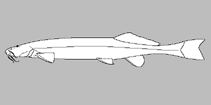
ก้านครีบอ่อนที่หาง (รวม) : 12; ก้านครีบอ่อนที่ก้น: 10; สัตว์มีกระดูกสันหลัง: 35 - 36. Diagnosed from all other species in the Trichomycteridae by the deep posterior region of the body, including the caudal peduncle and caudal fin (caudal-peduncle depth 22.8-25.4% SL in adults). Distinguished also from all members of the genus Trichomycterus by the shape of the caudal fin in adults, in which the fin is prolonged into long, markedly diverging and somewhat irregular lobes forming a concave posterior margin (vs. caudal fin either truncate, emarginate, or round). In addition, it can be separated from all other congeners and possibly all other trichomycterids by pronounced elongation of the neural and hemal spines of the caudal vertebrae along the mid-portion of the caudal peduncle. Differs further from all other trichomycterids, except Trichomycterus stawiarski, by having thick-ossified and rigid procurrent caudal-fin rays, markedly distinct from the flexible and splint-like procurrent rays in other trichomycterids. The coloration pattern consists of closely set large irregular blotches overlain by a more superficial layer of small round markings, which distinguishes this species from the majority of other species currently in Trichomycterus, except Trichomycterus stawiarski. Additional characters useful for recognizing this species which could not be checked in all species of Trichomycteridae include urohyal foramen reduced to a slender canal and lateral line with 5-7 pores (Ref. 75785).
Body shape (shape guide): elongated.
Found in a river with substrate composed of angular basaltic rocks and pebble. Collected also in a sector of the river with strong current and 1.2 m depth (Ref. 75785).
วงจรชีวิตและพฤติกรรมการผสมพันธุ์
วัยเจริญพันธุ์ | การสืบพันธุ์ | การวางไข่ | เซลสืบพันธ์ของเพศเมีย(ไข่) | ความดกของไข่ | ตัวอ่อน
Wosiacki, W.B. and M. de Pinna, 2008. A new species of the neotropical catfish genus Trichomycterus (Siluriformes: Trichomycteridae) representing a new body shape for the family. Copeia 2008(2):273-278. (Ref. 75785)
สถานะบัญชีแดงของ IUCN (Ref. 130435: Version 2025-2 (Global))
ภัยคุกคามต่อมนุษย์
Harmless
การใช้ของมนุษย์
เครื่องมือ
รายงานพิเศษ
ดาวน์โหลด XML
แหล่งที่มาจากอินเตอร์เน็ต
การประมาณค่าตามแบบจำลอง
ดัชนีความหลากหลายทางวิวัฒนาการ (อ้างอิง
82804): PD
50 = 0.5000 [Uniqueness, from 0.5 = low to 2.0 = high].
Bayesian length-weight: a=0.00912 (0.00396 - 0.02102), b=2.97 (2.79 - 3.15), in cm total length, based on LWR estimates for this Genus-body shape (Ref.
93245).
ระดับชั้นอาหาร (อ้างอิง
69278): 3.3 ±0.4 se; based on size and trophs of closest relatives
ความเสี่ยงต่อการตกปลา (Ref.
59153): Low vulnerability (10 of 100).
🛈