>
Ovalentaria/misc (Various families in series Ovalentaria) >
Pomacentridae (Damselfishes) > Chrominae
Etymology: Chromis: Greek, chromis = a fish, perhaps a perch (Ref. 45335); onumai: Named for Hisashi Onuma, who first discovered the species.
Eponymy: Hisashi Onuma “who was the first to discover the species” was also thanked for his assistance in collecting the new damselfish at Izu-oshima Island, Japan, “and for his excellent underwater photographs.” (Ref. 128868), visit book page.
Environnement : milieu / zone climatique / profondeur / gamme de distribution
Écologie
marin récifal; profondeur 51 - 90 m (Ref. 75861). Temperate
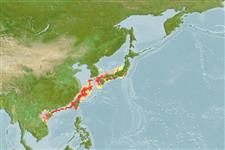
Northwest Pacific: Taiwan and Japan.
Taille / Poids / Âge
Maturité: Lm ? range ? - ? cm
Max length : 12.6 cm SL mâle / non sexé; (Ref. 75861)
Description synthétique
Clés d'identification | Morphologie | Morphométrie
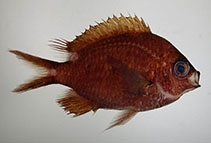
Épines dorsales (Total) : 14; Rayons mous dorsaux (Total) : 12 - 13; Épines anales: 2; Rayons mous anaux: 12 - 13; Vertèbres: 26. This species is characterized by the following: D XIV, 12-13; A II, 12-13; pectoral fin rays 19-20; 3 spiniform caudal fin rays; 16-17 tubed lateral line scales; gill rakers 5-7 + 19-20 = 25-27; white spots about a pupil size posteriorly, 1 at rear base of dorsal fin, another at the rear base of anal fin, and the third at mid base of caudal fin (these 3 spots usually fading after death, but may be visible as a pale area on preserved specimen) (Ref. 75861).
Body shape (shape guide): short and / or deep; Cross section: compressed.
Life history characteristics for the family specify that this group is oviparous, with distinct pairing during breeding (Ref. 205). Eggs are demersal and adhere to the substrate (Ref. 205). Males guard and aerate the eggs (Ref. 205).
Cycle de vie et comportement reproducteur
Maturité | Reproduction | Frai | Œufs | Fécondité | Larves
Oviparous, distinct pairing during breeding (Ref. 205). Eggs are demersal and adhere to the substrate (Ref. 205). Males guard and aerate the eggs (Ref. 205).
Senou, H. and T. Kudo, 2007. A new species of the genus Chromis (Perciformes: Pomacentridae) from Taiwan and Japan. Bull. Nat. Mus. Nat. Sci. Ser. A. Suppl. 1:51-57. (Ref. 75861)
Statut dans la liste rouge de l'IUCN (Ref. 130435: Version 2025-2 (Global))
Menace pour l'homme
Harmless
Utilisations par l'homme
Outils
Articles particuliers
Télécharger en XML
Sources Internet
Estimations basées sur des modèles
Température préférée (Réf.
123201): 17.2 - 23.7, mean 21.9 °C (based on 22 cells).
Indice de diversité phylogénétique (Réf.
82804): PD
50 = 0.5000 [Uniqueness, from 0.5 = low to 2.0 = high].
Bayesian length-weight: a=0.01778 (0.00800 - 0.03953), b=3.00 (2.82 - 3.18), in cm total length, based on LWR estimates for this Genus-body shape (Ref.
93245).
Niveau trophique (Réf.
69278): 3.0 ±0.1 se; based on size and trophs of closest relatives
Résilience (Réf.
120179): Haut, temps minimum de doublement de population inférieur à 15 mois (Preliminary K or Fecundity.).
Vulnérabilité de la pêche (Ref.
59153): Low vulnerability (10 of 100).
🛈