>
Ovalentaria/misc (Various families in series Ovalentaria) >
Pomacentridae (Damselfishes) > Chrominae
Etymology: Chromis: Greek, chromis = a fish, perhaps a perch (Ref. 45335); onumai: Named for Hisashi Onuma, who first discovered the species.
Eponymy: Hisashi Onuma “who was the first to discover the species” was also thanked for his assistance in collecting the new damselfish at Izu-oshima Island, Japan, “and for his excellent underwater photographs.” (Ref. 128868), visit book page.
Ambiente: milieu / zona climatica / distribuzione batimetrica / gamma di distribuzione
Ecologia
marino associati a barriera corallina; distribuzione batimetrica 51 - 90 m (Ref. 75861). Temperate
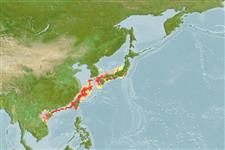
Northwest Pacific: Taiwan and Japan.
Dimensione / Peso / Età
Maturità: Lm ? range ? - ? cm
Max length : 12.6 cm SL maschio/sesso non determinato; (Ref. 75861)
Breve descrizione
Chiavi di identificazione | Morfologia | Morfometria
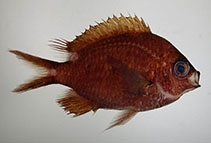
Spine dorsali (totale) : 14; Raggi dorsali molli (totale) : 12 - 13; Spine anali: 2; Raggi anali molli: 12 - 13; Vertebre: 26. This species is characterized by the following: D XIV, 12-13; A II, 12-13; pectoral fin rays 19-20; 3 spiniform caudal fin rays; 16-17 tubed lateral line scales; gill rakers 5-7 + 19-20 = 25-27; white spots about a pupil size posteriorly, 1 at rear base of dorsal fin, another at the rear base of anal fin, and the third at mid base of caudal fin (these 3 spots usually fading after death, but may be visible as a pale area on preserved specimen) (Ref. 75861).
Body shape (shape guide): short and / or deep; Cross section: compressed.
Life history characteristics for the family specify that this group is oviparous, with distinct pairing during breeding (Ref. 205). Eggs are demersal and adhere to the substrate (Ref. 205). Males guard and aerate the eggs (Ref. 205).
Ciclo vitale e comportamento di accoppiamento
Maturità | Riproduzione | Deposizione | Uova | Fecondità | Larve
Oviparous, distinct pairing during breeding (Ref. 205). Eggs are demersal and adhere to the substrate (Ref. 205). Males guard and aerate the eggs (Ref. 205).
Senou, H. and T. Kudo, 2007. A new species of the genus Chromis (Perciformes: Pomacentridae) from Taiwan and Japan. Bull. Nat. Mus. Nat. Sci. Ser. A. Suppl. 1:51-57. (Ref. 75861)
Stato della Lista Rossa IUCN (Ref. 130435: Version 2025-2 (Global))
Minaccia per l'uomo
Harmless
Usi umani
Strumenti
Rapporti speciali
Scarica XML
Fonti Internet
Stime basate su modelli
Temperatura preferita (Fonte Biblio.
123201): 17.2 - 23.7, mean 21.9 °C (based on 22 cells).
Indice di diversità filogenetica (Fonte Biblio.
82804): PD
50 = 0.5000 [Uniqueness, from 0.5 = low to 2.0 = high].
Bayesian length-weight: a=0.01778 (0.00800 - 0.03953), b=3.00 (2.82 - 3.18), in cm total length, based on LWR estimates for this Genus-body shape (Ref.
93245).
Livello trofico (Fonte Biblio.
69278): 3.0 ±0.1 se; based on size and trophs of closest relatives
Resilienza (Fonte Biblio.
120179): Alto, tempo minimo di raddoppiamento della popolazione meno di 15 mesi (Preliminary K or Fecundity.).
Vulnerabilità della pesca (Ref.
59153): Low vulnerability (10 of 100).
🛈