Klassifizierung / Names
Namen | Synonyme | Catalog of Fishes(Gattung, Arten) | ITIS | CoL | WoRMS | Cloffa
>
Characiformes (Characins) >
Characidae (Characins; tetras) > Characinae
Etymology: Acestrocephalus: Greek, agkistron = hook + Greek, kepahle = head (Ref. 45335); nigrifasciatus: Derived from Latin adjectives, niger means black, and fasciatus which is also derived from fascia means band or stripe. This is in reference to the dark lateral body stripe of this species.
Umwelt: Milieu / Klimazone / Tiefenbereich / Verbreitungsgebiet
Ökologie
; süßwasser benthopelagisch. Tropical
South America: Rio Arinos and Rio Juruena, and rio Tapajós basin in Brazil.
Größe / Gewicht / Alter
Geschlechtsreife: Lm ? range ? - ? cm
Max length : 9.3 cm SL Männchen/unbestimmt; (Ref. 75890)
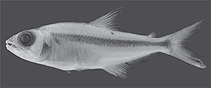
Rückenflossenweichstrahlen (insgesamt) : 11; Afterflossenweichstrahlen: 31 - 35; Wirbelzahl: 37 - 38. Both Acestrocephalus nigrifasciatus and Acestrocephalus sardina have the same color pattern and eye size, distinct from all their congeners. In addition, Acestrocephalus nigrifasciatus has more scale rows above (13-14 vs. 10-12) and below (12-13 vs. 10-12) lateral line. Differs from Acestrocephalus sardina by having longer and narrower muscular hiatus of the pseudotympanum than that of Acestrocephalus sardina; and the fibers of the obliquus inferioris muscle are not visible as in the latter species (Ref. 75890).
Body shape (shape guide): fusiform / normal.
Lebenszyklus und Paarungsverhalten
Geschlechtsreife | Fortpflanzung | Ablaichen | Eier | Fruchtbarkeit | Larven
Menezes, N.A., 2006. Description of five new species of Acestrocephalus Eigenmann and redescription of A. sardina and A. boehlkei (Characiformes: Characidae). Neotrop. Ichthyol. 4(4):385-400. (Ref. 75890)
IUCN Rote Liste Status (Ref. 130435: Version 2025-2 (Global))
Bedrohung für Menschen
Harmless
Nutzung durch Menschen
Tools
Zusatzinformationen
Download XML
Internet Quellen
Schätzungen auf der Grundlage von Modellen
Phylogenetischer Diversitätsindex (Ref.
82804): PD
50 = 0.5039 [Uniqueness, from 0.5 = low to 2.0 = high].
Bayesian length-weight: a=0.01000 (0.00444 - 0.02253), b=3.09 (2.89 - 3.29), in cm total length, based on LWR estimates for this (Sub)family-body shape (Ref.
93245).
Trophische Ebene (Ref.
69278): 3.6 ±0.6 se; based on size and trophs of closest relatives
Anfälligkeit der Fischerei (Ref.
59153): Low vulnerability (10 of 100).
🛈