Clasificación / Nombres
Nombres comunes | Sinónimos | Catalog of Fishes(Género, Especie) | ITIS | CoL | WoRMS | Cloffa
>
Characiformes (Characins) >
Characidae (Characins; tetras) > Characinae
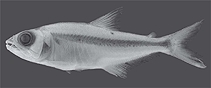
Etymology: Acestrocephalus: Greek, agkistron = hook + Greek, kepahle = head (Ref. 45335); nigrifasciatus: Derived from Latin adjectives, niger means black, and fasciatus which is also derived from fascia means band or stripe. This is in reference to the dark lateral body stripe of this species.
Entorno: milieu / zona climática / rango de profundidad / gama de distribución
Ecología
; agua dulce bentopelágico. Tropical
South America: Rio Arinos and Rio Juruena, and rio Tapajós basin in Brazil.
Tamaño / Peso / Edad
Madurez: Lm ? range ? - ? cm
Max length : 9.3 cm SL macho / no sexado; (Ref. 75890)
Descripción breve
Claves de identificación | Morfología | Morfometría
Radios blandos dorsales (total) : 11; Radios blandos anales: 31 - 35; Vértebra: 37 - 38. Both Acestrocephalus nigrifasciatus and Acestrocephalus sardina have the same color pattern and eye size, distinct from all their congeners. In addition, Acestrocephalus nigrifasciatus has more scale rows above (13-14 vs. 10-12) and below (12-13 vs. 10-12) lateral line. Differs from Acestrocephalus sardina by having longer and narrower muscular hiatus of the pseudotympanum than that of Acestrocephalus sardina; and the fibers of the obliquus inferioris muscle are not visible as in the latter species (Ref. 75890).
Body shape (shape guide): fusiform / normal.
Ciclo vital y comportamiento de apareamiento
Madurez | Reproducción | Puesta | Huevos | Fecundidad | Larva
Menezes, N.A., 2006. Description of five new species of Acestrocephalus Eigenmann and redescription of A. sardina and A. boehlkei (Characiformes: Characidae). Neotrop. Ichthyol. 4(4):385-400. (Ref. 75890)
Situación en la Lista Roja de la UICN (Ref. 130435: Version 2025-2 (Global))
Amenaza para el ser humano
Harmless
Usos humanos
Herramientas
Informes especiales
Descargar XML
Fuentes de Internet
Estimaciones basadas en modelos
Índice de diversidad filogenética (Referencia
82804): PD
50 = 0.5039 [Uniqueness, from 0.5 = low to 2.0 = high].
Bayesian length-weight: a=0.01000 (0.00444 - 0.02253), b=3.09 (2.89 - 3.29), in cm total length, based on LWR estimates for this (Sub)family-body shape (Ref.
93245).
Nivel trófico (Referencia
69278): 3.6 ±0.6 se; based on size and trophs of closest relatives
Vulnerabilidad pesquera (Ref.
59153): Low vulnerability (10 of 100).
🛈