>
Cyprinodontiformes (Rivulines, killifishes and live bearers) >
Poeciliidae (Poeciliids) > Poeciliinae
Etymology: Phalloceros: Greek, phallos = penis + Greek, keras = horn (Ref. 45335); leptokeras: From the Greek leptos meaning strait, narrow plus kéras meaning horn, alluding to the slender gonopodial appendix. leptokeras is a
noun in apposition.
Milieu: milieu / Klimaatzone / Diepte / verspreidingsgebied
Ecologie
; zoet water pelagisch. Tropical; 22°S - , 42°W -
South America: Brazil: Middle portions of rio Paraíba do Sul drainage (Ref. 76852).
Grootte / Gewicht / Leeftijd
Maturiteit: Lm ? range ? - ? cm
Max length : 2.4 cm SL mannelijk / geslacht onbekend; (Ref. 76852); 3.7 cm SL (female)
Korte beschrijving
Determinatiesleutels | Morfologie | Morfometrie
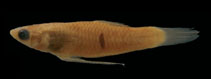
Dorsale zachte stralen (totaal) : 8; Anale zachte stralen: 8 - 11; Wervels: 32 - 33. Distinguished by the following uniquely derived autapomorphy: typical densely pigmented rectangle like lateral spot located on the 14th or 15th (very rarely 16th) scale of longitudinal line. Can be readily differentiated from its congeners, except Phalloceros tupinamba and Phalloceros aspilos, by the presence a lateral ramus of the female urogenital papilla; female urogenital papilla left turned; large sickle like hook on the gonopodial appendix located in its inner surface and close to its base; and absence of vertical bars along body sides. Phalloceros leptokeras can be distinguished from Phalloceros aspilos by the presence of lateral spot (vs. spot absent). Phalloceros leptokeras can be distinguished from P. tupinamba by the flattened female urogenital papilla (vs. not-flattened in Phalloceros tupinamba) and by the lateral spot densely pigmented, rectangle like, horizontally covering the length corresponding to two or three scales length (vs. normally pigmented, vertically elongated, and horizontally covering the length corresponding to the length of one scale in Phalloceros tupinamba) (Ref. 76852).
Levenscyclus en paargedrag
Maturiteit | Voortplanting | Paaien | Eieren | Fecunditeit | Larven
Lucinda, P.H.F., 2008. Systematics and biogeography of the genus Phalloceros Eigenmann, 1907 (Cyprinodontiformes: Poeciliidae: Poeciliinae), with the description of twenty-one new species. Neotrop. Ichthyol. 6(2):113-158. (Ref. 76852)
Status op de Rode Lijst van het IUCN (Ref. 130435: Version 2025-2 (Global))
Gevaar voor de mens
Harmless
Gebruik door de mens
Tools
Speciale rapporten
Download XML
Internetbronnen
Schattingen op basis van modellen
Fylogenetische diversiteitsindex (Ref.
82804): PD
50 = 0.5000 [Uniqueness, from 0.5 = low to 2.0 = high].
Bayesian length-weight: a=0.00851 (0.00369 - 0.01962), b=3.15 (2.96 - 3.34), in cm total length, based on LWR estimates for this (Sub)family-body shape (Ref.
93245).
Trofisch niveau (Ref.
69278): 3.0 ±0.4 se; based on size and trophs of closest relatives
Weerstandsvermogen (Ref.
120179): Hoog, minimale populatieverdubbelingstijd minder dan 15 maanden (Preliminary K or Fecundity.).
Kwetsbaarheid van de visserij (Ref.
59153): Low vulnerability (10 of 100).
🛈