>
Cyprinodontiformes (Rivulines, killifishes and live bearers) >
Poeciliidae (Poeciliids) > Poeciliinae
Etymology: Phalloceros: Greek, phallos = penis + Greek, keras = horn (Ref. 45335); leptokeras: From the Greek leptos meaning strait, narrow plus kéras meaning horn, alluding to the slender gonopodial appendix. leptokeras is a
noun in apposition.
Entorno: milieu / zona climática / rango de profundidad / gama de distribución
Ecología
; agua dulce pelágico. Tropical; 22°S - , 42°W -
South America: Brazil: Middle portions of rio Paraíba do Sul drainage (Ref. 76852).
Tamaño / Peso / Edad
Madurez: Lm ? range ? - ? cm
Max length : 2.4 cm SL macho / no sexado; (Ref. 76852); 3.7 cm SL (female)
Descripción breve
Claves de identificación | Morfología | Morfometría
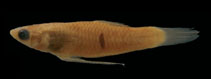
Radios blandos dorsales (total) : 8; Radios blandos anales: 8 - 11; Vértebra: 32 - 33. Distinguished by the following uniquely derived autapomorphy: typical densely pigmented rectangle like lateral spot located on the 14th or 15th (very rarely 16th) scale of longitudinal line. Can be readily differentiated from its congeners, except Phalloceros tupinamba and Phalloceros aspilos, by the presence a lateral ramus of the female urogenital papilla; female urogenital papilla left turned; large sickle like hook on the gonopodial appendix located in its inner surface and close to its base; and absence of vertical bars along body sides. Phalloceros leptokeras can be distinguished from Phalloceros aspilos by the presence of lateral spot (vs. spot absent). Phalloceros leptokeras can be distinguished from P. tupinamba by the flattened female urogenital papilla (vs. not-flattened in Phalloceros tupinamba) and by the lateral spot densely pigmented, rectangle like, horizontally covering the length corresponding to two or three scales length (vs. normally pigmented, vertically elongated, and horizontally covering the length corresponding to the length of one scale in Phalloceros tupinamba) (Ref. 76852).
Ciclo vital y comportamiento de apareamiento
Madurez | Reproducción | Puesta | Huevos | Fecundidad | Larva
Lucinda, P.H.F., 2008. Systematics and biogeography of the genus Phalloceros Eigenmann, 1907 (Cyprinodontiformes: Poeciliidae: Poeciliinae), with the description of twenty-one new species. Neotrop. Ichthyol. 6(2):113-158. (Ref. 76852)
Situación en la Lista Roja de la UICN (Ref. 130435: Version 2025-2 (Global))
Amenaza para el ser humano
Harmless
Usos humanos
Herramientas
Informes especiales
Descargar XML
Fuentes de Internet
Estimaciones basadas en modelos
Índice de diversidad filogenética (Referencia
82804): PD
50 = 0.5000 [Uniqueness, from 0.5 = low to 2.0 = high].
Bayesian length-weight: a=0.00851 (0.00369 - 0.01962), b=3.15 (2.96 - 3.34), in cm total length, based on LWR estimates for this (Sub)family-body shape (Ref.
93245).
Nivel trófico (Referencia
69278): 3.0 ±0.4 se; based on size and trophs of closest relatives
Resiliencia (Referencia
120179): Alto, población duplicada en un tiempo mínimo inferior a 15 meses (Preliminary K or Fecundity.).
Vulnerabilidad pesquera (Ref.
59153): Low vulnerability (10 of 100).
🛈