>
Cyprinodontiformes (Rivulines, killifishes and live bearers) >
Poeciliidae (Poeciliids) > Poeciliinae
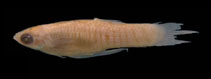
Etymology: Phalloceros: Greek, phallos = penis + Greek, keras = horn (Ref. 45335); buckupi: Named for Paulo A. Buckup (collector of most specimens of this species), in recognition of his many contributions to Neotropical ichthyology.
Eponymy: Dr Paulo Andreas Buckup (d: 1959) is an ichthyologist (1994–present) who is a Professor in the Vertebrates Department of the Brazilian National Museum at the Federal University of Rio de Janeiro (UFRJ) and Curator of the fish collection. [...] (Ref. 128868), visit book page.
Milieu: milieu / Klimaatzone / Diepte / verspreidingsgebied
Ecologie
; zoet water benthopelagisch. Tropical
South America: Rio Jacareí drainage and neighbouring, which flows into the Baía de Paranaguá in Paraná, Brazil.
Grootte / Gewicht / Leeftijd
Maturiteit: Lm ? range ? - ? cm
Max length : 2.0 cm SL mannelijk / geslacht onbekend; (Ref. 76852); 3.3 cm SL (female)
Korte beschrijving
Determinatiesleutels | Morfologie | Morfometrie
Dorsale zachte stralen (totaal) : 7 - 8; Anale zachte stralen: 9 - 10; Wervels: 32. Diagnosed from all other species of the genus except Phalloceros megapolos, Phalloceros spiloura, Phalloceros malabarbai, Phalloceros alessandrae, Phalloceros anisophallos, Phalloceros uai, Phalloceros lucenorum, Phalloceros pellos, and Phalloceros reisi by the female urogenital papilla curved
to the right, located laterally (vs. slightly left turned and with a lateral ramus or straight located along midventral line); and border of the anal aperture in contact with the first anal-fin ray or very close to it (vs. separated from first anal-fin ray by the female urogenital papilla). Differs from Phalloceros spiloura by the absence of a caudal peduncle spot (vs. presence
of caudal peduncle spot); from Phalloceros megapolos by the gonopodium appendix normally developed (vs. greatly expanded in wing like projections); from Phalloceros uai by the absence of a wide and square-shaped lateral spot in large specimens (vs. presence of such spot). Distinguished from Phalloceros alessandrae and Phalloceros malabarbai by halves of gonopodial paired appendix sickle like (vs. not sickle like); medial corner absent (vs. present); hook on left half of gonopodial paired appendix and right hook absent (vs. hook on both halves of gonopodial paired appendix); and left hook small, directed downward or up- and forward, and located closer to the base of gonopodial appendix (vs. hooks large downward directed and located in the corner of gonopodial appendix). Differs from Phalloceros anisophallos, Phalloceros lucenorum, Phalloceros pellos, and Phalloceros reisi by the halves of the gonopodium slender and similar to each other (vs. halves of the gonopodium wide and different from each other; right half wider than left one) (Ref. 76852).
Levenscyclus en paargedrag
Maturiteit | Voortplanting | Paaien | Eieren | Fecunditeit | Larven
Lucinda, P.H.F., 2008. Systematics and biogeography of the genus Phalloceros Eigenmann, 1907 (Cyprinodontiformes: Poeciliidae: Poeciliinae), with the description of twenty-one new species. Neotrop. Ichthyol. 6(2):113-158. (Ref. 76852)
Status op de Rode Lijst van het IUCN (Ref. 130435: Version 2025-2 (Global))
Gevaar voor de mens
Harmless
Gebruik door de mens
Tools
Speciale rapporten
Download XML
Internetbronnen
Schattingen op basis van modellen
Fylogenetische diversiteitsindex (Ref.
82804): PD
50 = 0.5000 [Uniqueness, from 0.5 = low to 2.0 = high].
Bayesian length-weight: a=0.00851 (0.00369 - 0.01962), b=3.15 (2.96 - 3.34), in cm total length, based on LWR estimates for this (Sub)family-body shape (Ref.
93245).
Trofisch niveau (Ref.
69278): 3.0 ±0.4 se; based on size and trophs of closest relatives
Weerstandsvermogen (Ref.
120179): Hoog, minimale populatieverdubbelingstijd minder dan 15 maanden (Preliminary K or Fecundity.).
Kwetsbaarheid van de visserij (Ref.
59153): Low vulnerability (10 of 100).
🛈