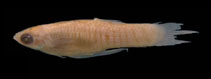
Классификация / Имена
народные названия | синонимы | Catalog of Fishes(род, виды) | ITIS | CoL | WoRMS | Cloffa
>
Cyprinodontiformes (Rivulines, killifishes and live bearers) >
Poeciliidae (Poeciliids) > Poeciliinae
Etymology: Phalloceros: Greek, phallos = penis + Greek, keras = horn (Ref. 45335); buckupi: Named for Paulo A. Buckup (collector of most specimens of this species), in recognition of his many contributions to Neotropical ichthyology.
Eponymy: Dr Paulo Andreas Buckup (d: 1959) is an ichthyologist (1994–present) who is a Professor in the Vertebrates Department of the Brazilian National Museum at the Federal University of Rio de Janeiro (UFRJ) and Curator of the fish collection. [...] (Ref. 128868), visit book page.
Окружающая среда: среда / климатическая зона / пределы глубины / диапазон распространения
экология
; пресноводный донно-пелагический. Tropical
South America: Rio Jacareí drainage and neighbouring, which flows into the Baía de Paranaguá in Paraná, Brazil.
Размер / Вес / Возраст
половая зрелость: Lm ? range ? - ? cm
Max length : 2.0 cm SL самец/пол неопределен; (Ref. 76852); 3.3 cm SL (female)
Краткое описание
определительные ключи | морфология | морфометрия
членистые (мягкие) лучи спинного плавника (общее число) : 7 - 8; членистые (мягкие) лучи анального плавника: 9 - 10; позвонки: 32. Diagnosed from all other species of the genus except Phalloceros megapolos, Phalloceros spiloura, Phalloceros malabarbai, Phalloceros alessandrae, Phalloceros anisophallos, Phalloceros uai, Phalloceros lucenorum, Phalloceros pellos, and Phalloceros reisi by the female urogenital papilla curved
to the right, located laterally (vs. slightly left turned and with a lateral ramus or straight located along midventral line); and border of the anal aperture in contact with the first anal-fin ray or very close to it (vs. separated from first anal-fin ray by the female urogenital papilla). Differs from Phalloceros spiloura by the absence of a caudal peduncle spot (vs. presence
of caudal peduncle spot); from Phalloceros megapolos by the gonopodium appendix normally developed (vs. greatly expanded in wing like projections); from Phalloceros uai by the absence of a wide and square-shaped lateral spot in large specimens (vs. presence of such spot). Distinguished from Phalloceros alessandrae and Phalloceros malabarbai by halves of gonopodial paired appendix sickle like (vs. not sickle like); medial corner absent (vs. present); hook on left half of gonopodial paired appendix and right hook absent (vs. hook on both halves of gonopodial paired appendix); and left hook small, directed downward or up- and forward, and located closer to the base of gonopodial appendix (vs. hooks large downward directed and located in the corner of gonopodial appendix). Differs from Phalloceros anisophallos, Phalloceros lucenorum, Phalloceros pellos, and Phalloceros reisi by the halves of the gonopodium slender and similar to each other (vs. halves of the gonopodium wide and different from each other; right half wider than left one) (Ref. 76852).
Жизненный цикл и брачное поведение
половая зрелость | размножение | нерест | икра | Плодовитость | личинки
Lucinda, P.H.F., 2008. Systematics and biogeography of the genus Phalloceros Eigenmann, 1907 (Cyprinodontiformes: Poeciliidae: Poeciliinae), with the description of twenty-one new species. Neotrop. Ichthyol. 6(2):113-158. (Ref. 76852)
Статус Красного Списка МСОП (Ref. 130435: Version 2025-2 (Global))
Угроза для людей
Harmless
Использование человеком
дополнительная информация
инструменты
Специальные отчеты
Скачать в формате XML
ресурсы в Интернет
Оценки, основанные на моделях
Индекс филогенетического разнообразия (ссылка
82804): PD
50 = 0.5000 [Uniqueness, from 0.5 = low to 2.0 = high].
Bayesian length-weight: a=0.00851 (0.00369 - 0.01962), b=3.15 (2.96 - 3.34), in cm total length, based on LWR estimates for this (Sub)family-body shape (Ref.
93245).
Трофический уровень (ссылка
69278): 3.0 ±0.4 se; based on size and trophs of closest relatives
устойчивость к внешним воздействиям (ссылка
120179): высокий, минимальное время удвоения популяции до 15 месяцев (Preliminary K or Fecundity.).
Уязвимость рыбной ловли (Ref.
59153): Low vulnerability (10 of 100).
🛈