Environnement : milieu / zone climatique / profondeur / gamme de distribution
Écologie
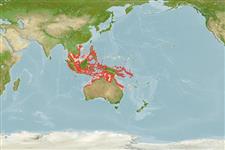
marin récifal; non migrateur; profondeur 1 - 50 m (Ref. 9710). Tropical; 20°N - 24°S, 97°E - 163°E (Ref. 5222)
Western Pacific: Philippines to Australia (Dampier Islands, off Western Australia to the Capricorn Islands, of the southern Great Barrier Reef); including Palau, New Britain, and the Solomon Islands.
Taille / Poids / Âge
Maturité: Lm ? range ? - ? cm
Max length : 55.0 cm TL mâle / non sexé; (Ref. 118794)
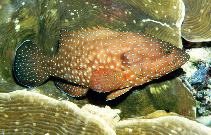
Épines dorsales (Total) : 9; Rayons mous dorsaux (Total) : 15 - 17; Épines anales: 3; Rayons mous anaux: 7 - 8. Juveniles dark brown with bright yellow dorsal, anal, pelvic and tail fins. At size about 9 cm, small scattered blue dots appear and yellow on fins begins to recede (Ref. 37816); characterized further by brown to reddish brown color, usually mottled; head, body and fins covered with numerous white to bluish spots; several pale bars evident on side; scales ctenoid scales on body including abdomen; greatest body depth 2.6-3.0 in SL; rounded caudal fin; pelvic fins 1.8-2.1 in head length (Ref. 90102).
Body shape (shape guide): fusiform / normal; Cross section: oval.
Inhabits shallow protected coastal reefs, in seagrass beds, and in coral-rich areas (Ref. 9710, 48635). Feeds on crustaceans and fishes (Ref. 37816). Solitary (Ref 90102). Protogynous hermaphrodite (Ref. 089707).
Cycle de vie et comportement reproducteur
Maturité | Reproduction | Frai | Œufs | Fécondité | Larves
Heemstra, P.C. and J.E. Randall, 1993. FAO Species Catalogue. Vol. 16. Groupers of the world (family Serranidae, subfamily Epinephelinae). An annotated and illustrated catalogue of the grouper, rockcod, hind, coral grouper and lyretail species known to date. Rome: FAO. FAO Fish. Synop. 125(16):382 p. (Ref. 5222)
Statut dans la liste rouge de l'IUCN (Ref. 130435: Version 2025-2 (Global))
Menace pour l'homme
Harmless
Utilisations par l'homme
Pêcheries: intérêt commercial mineur
Outils
Articles particuliers
Télécharger en XML
Sources Internet
Estimations basées sur des modèles
Température préférée (Réf.
123201): 25.6 - 29, mean 28.3 °C (based on 758 cells).
Indice de diversité phylogénétique (Réf.
82804): PD
50 = 0.5000 [Uniqueness, from 0.5 = low to 2.0 = high].
Bayesian length-weight: a=0.01230 (0.00802 - 0.01887), b=3.02 (2.90 - 3.14), in cm total length, based on LWR estimates for this species & Genus-body shape (Ref.
93245).
Niveau trophique (Réf.
69278): 4.2 ±0.74 se; based on food items.
Generation time: 11.4 ( na - na) years. Estimated as median ln(3)/K based on 2
growth studies.
Résilience (Réf.
120179): Très faible, temps minimum de doublement de population supérieur à 14 ans (Preliminary K or Fecundity.).
Vulnérabilité de la pêche (Ref.
59153): High vulnerability (58 of 100).
🛈
Nutriments (Ref.
124155): Calcium = 46.2 [26.4, 79.2] mg/100g; Iron = 0.541 [0.310, 0.998] mg/100g; Protein = 18.5 [16.7, 20.1] %; Omega3 = 0.161 [0.104, 0.249] g/100g; Selenium = 34.1 [19.4, 56.7] μg/100g; VitaminA = 172 [62, 542] μg/100g; Zinc = 0.797 [0.580, 1.275] mg/100g (wet weight);