Entorno: milieu / zona climática / rango de profundidad / gama de distribución
Ecología
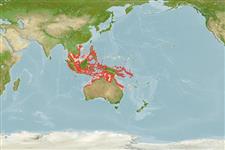
marino asociado a arrecife; no migratorio; rango de profundidad 1 - 50 m (Ref. 9710). Tropical; 20°N - 24°S, 97°E - 163°E (Ref. 5222)
Western Pacific: Philippines to Australia (Dampier Islands, off Western Australia to the Capricorn Islands, of the southern Great Barrier Reef); including Palau, New Britain, and the Solomon Islands.
Tamaño / Peso / Edad
Madurez: Lm ? range ? - ? cm
Max length : 55.0 cm TL macho / no sexado; (Ref. 118794)
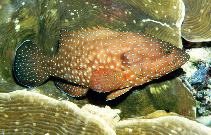
Espinas dorsales (total) : 9; Radios blandos dorsales (total) : 15 - 17; Espinas anales: 3; Radios blandos anales: 7 - 8. Juveniles dark brown with bright yellow dorsal, anal, pelvic and tail fins. At size about 9 cm, small scattered blue dots appear and yellow on fins begins to recede (Ref. 37816); characterized further by brown to reddish brown color, usually mottled; head, body and fins covered with numerous white to bluish spots; several pale bars evident on side; scales ctenoid scales on body including abdomen; greatest body depth 2.6-3.0 in SL; rounded caudal fin; pelvic fins 1.8-2.1 in head length (Ref. 90102).
Body shape (shape guide): fusiform / normal; Cross section: oval.
Inhabits shallow protected coastal reefs, in seagrass beds, and in coral-rich areas (Ref. 9710, 48635). Feeds on crustaceans and fishes (Ref. 37816). Solitary (Ref 90102). Protogynous hermaphrodite (Ref. 089707).
Ciclo vital y comportamiento de apareamiento
Madurez | Reproducción | Puesta | Huevos | Fecundidad | Larva
Heemstra, P.C. and J.E. Randall, 1993. FAO Species Catalogue. Vol. 16. Groupers of the world (family Serranidae, subfamily Epinephelinae). An annotated and illustrated catalogue of the grouper, rockcod, hind, coral grouper and lyretail species known to date. Rome: FAO. FAO Fish. Synop. 125(16):382 p. (Ref. 5222)
Situación en la Lista Roja de la UICN (Ref. 130435: Version 2025-2 (Global))
Amenaza para el ser humano
Harmless
Usos humanos
Pesquerías: escaso valor comercial
Herramientas
Informes especiales
Descargar XML
Fuentes de Internet
Estimaciones basadas en modelos
Temperatura preferida (Referencia
123201): 25.6 - 29, mean 28.3 °C (based on 758 cells).
Índice de diversidad filogenética (Referencia
82804): PD
50 = 0.5000 [Uniqueness, from 0.5 = low to 2.0 = high].
Bayesian length-weight: a=0.01230 (0.00802 - 0.01887), b=3.02 (2.90 - 3.14), in cm total length, based on LWR estimates for this species & Genus-body shape (Ref.
93245).
Nivel trófico (Referencia
69278): 4.2 ±0.74 se; based on food items.
Generation time: 11.4 ( na - na) years. Estimated as median ln(3)/K based on 2
growth studies.
Resiliencia (Referencia
120179): Muy bajo, población duplicada en un tiempo mínimo superior a 14 años (Preliminary K or Fecundity.).
Vulnerabilidad pesquera (Ref.
59153): High vulnerability (58 of 100).
🛈
Nutrientes (Ref.
124155): Calcium = 46.2 [26.4, 79.2] mg/100g; Iron = 0.541 [0.310, 0.998] mg/100g; Protein = 18.5 [16.7, 20.1] %; Omega3 = 0.161 [0.104, 0.249] g/100g; Selenium = 34.1 [19.4, 56.7] μg/100g; VitaminA = 172 [62, 542] μg/100g; Zinc = 0.797 [0.580, 1.275] mg/100g (wet weight);