>
Syngnathiformes (Pipefishes and seahorses) >
Syngnathidae (Pipefishes and seahorses) > Syngnathinae
Etymology: Hippocampus: Greek, ippos = horse + Greek,kampe = curvature (Ref. 45335); pontohi: Named for Hence Pontoh, the Indonesian dive guide who first brought these pygmy seahorses to our attention.
Eponymy: Hence Pontoh is an Indonesian dive guide who first brought the authors’ attention to this species. We can find no further biography. (Ref. 128868), visit book page.
Milieu: milieu / Klimaatzone / Diepte / verspreidingsgebied
Ecologie
marien benthopelagisch; standvastig; diepte 3 - 25 m (Ref. 79848). Tropical
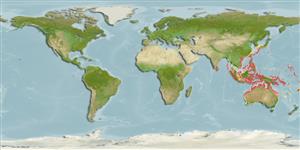
Western Pacific: Indonesia to the Solomon Is. and Fiji (Ref. 118476); north to Japan (Ref. 79848, 124757).
Grootte / Gewicht / Leeftijd
Maturiteit: Lm ? range ? - ? cm
Max length : 1.7 cm SL mannelijk / geslacht onbekend; (Ref. 79848); 1.6 cm SL (female)
Korte beschrijving
Determinatiesleutels | Morfologie | Morfometrie
Dorsale zachte stralen (totaal) : 12. This species is distinguished from its congeners by the following set of characters: 4 subdorsal rings; 2 pairs of bilaterally wing-like protrusions formed by a pair of large truncate spines projecting laterad on both first and second superior trunk ridges; flat laterodorsal surface on the third and fourth trunk rings; 28 tail rings 28; 14 dorsal-fin rays; 10 pectoral-fin rays (Ref. 118476).
Body shape (shape guide): other; Cross section: angular.
Hippocampus pontohi has been observed on the coralline algae Halimeda, as well as on the hydroid Aglaephenia cupressina (Müller and Severns, pers. comm.). Severns noted it particularly in areas where Halimeda is growing on reef walls. It has been recorded at a number of areas in Indonesia (Bunaken, Cape Sri, Sorong, Wakatobi, Lembeh Straits), at depths of between 11-25 m particularly on vertical walls or in rock fissures on current-swept walls where it will tend to occur on the side of the fissure that faces away from the current, but in all cases where there is some upward current (Müller, pers. comm.) and has been seen swimming over a fungiid coral (Hardt, pers. comm.). Hippocampus pontohi is commonly found in pairs and, like H. denise, is relatively active in the morning and late afternoon when it is not in direct sunlight (Müller, pers. comm.). Two of the specimens examined were pregnant and each contained approximately 11 embryos (Ref. 79848).
Levenscyclus en paargedrag
Maturiteit | Voortplanting | Paaien | Eieren | Fecunditeit | Larven
Male carries the eggs in a brood pouch (Ref. 205).
Lourie, S.A., R.A. Pollom and S.J. Foster, 2016. A global revision of the seahorses Hippocampus Rafinesque 1810 (Actinopterygii: Syngnathiformes): taxonomy and biogeography with recommendations for further research. Zootaxa 4146(1):1-66. (Ref. 115213)
Status op de Rode Lijst van het IUCN (Ref. 130435: Version 2025-2 (Global))
Gevaar voor de mens
Harmless
Gebruik door de mens
Tools
Speciale rapporten
Download XML
Internetbronnen
Schattingen op basis van modellen
Gewenste temperatuur (Ref.
123201): 25.4 - 29.3, mean 28.5 °C (based on 1509 cells).
Fylogenetische diversiteitsindex (Ref.
82804): PD
50 = 0.5000 [Uniqueness, from 0.5 = low to 2.0 = high].
Bayesian length-weight: a=0.00447 (0.00176 - 0.01132), b=3.00 (2.78 - 3.22), in cm total length, based on LWR estimates for this (Sub)family-body shape (Ref.
93245).
Trofisch niveau (Ref.
69278): 3.0 ±0.3 se; based on size and trophs of closest relatives
Weerstandsvermogen (Ref.
120179): Hoog, minimale populatieverdubbelingstijd minder dan 15 maanden (Preliminary K or Fecundity.).
Kwetsbaarheid van de visserij (Ref.
59153): Low vulnerability (10 of 100).
🛈