>
Syngnathiformes (Pipefishes and seahorses) >
Syngnathidae (Pipefishes and seahorses) > Syngnathinae
Etymology: Hippocampus: Greek, ippos = horse + Greek,kampe = curvature (Ref. 45335); pontohi: Named for Hence Pontoh, the Indonesian dive guide who first brought these pygmy seahorses to our attention.
Eponymy: Hence Pontoh is an Indonesian dive guide who first brought the authors’ attention to this species. We can find no further biography. (Ref. 128868), visit book page.
Môi trường: môi trường / vùng khí hậu / Mức độ sâu / phạm vi phân phối
Sinh thái học
biển sống nổi và đáy; không di cư; mức độ sâu 3 - 25 m (Ref. 79848). Tropical
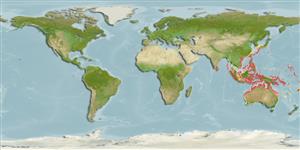
Western Pacific: Indonesia to the Solomon Is. and Fiji (Ref. 118476); north to Japan (Ref. 79848, 124757).
Bộ gần gũi / Khối lượng (Trọng lượng) / Tuổi
Chín muồi sinh dục: Lm ? range ? - ? cm
Max length : 1.7 cm SL con đực/không giới tính; (Ref. 79848); 1.6 cm SL (female)
Mô tả ngắn gọn
Khóa để định loại | Hình thái học | Sinh trắc học
Các vây lưng mềm (tổng cộng) : 12. This species is distinguished from its congeners by the following set of characters: 4 subdorsal rings; 2 pairs of bilaterally wing-like protrusions formed by a pair of large truncate spines projecting laterad on both first and second superior trunk ridges; flat laterodorsal surface on the third and fourth trunk rings; 28 tail rings 28; 14 dorsal-fin rays; 10 pectoral-fin rays (Ref. 118476).
Body shape (shape guide): other; Cross section: angular.
Hippocampus pontohi has been observed on the coralline algae Halimeda, as well as on the hydroid Aglaephenia cupressina (Müller and Severns, pers. comm.). Severns noted it particularly in areas where Halimeda is growing on reef walls. It has been recorded at a number of areas in Indonesia (Bunaken, Cape Sri, Sorong, Wakatobi, Lembeh Straits), at depths of between 11-25 m particularly on vertical walls or in rock fissures on current-swept walls where it will tend to occur on the side of the fissure that faces away from the current, but in all cases where there is some upward current (Müller, pers. comm.) and has been seen swimming over a fungiid coral (Hardt, pers. comm.). Hippocampus pontohi is commonly found in pairs and, like H. denise, is relatively active in the morning and late afternoon when it is not in direct sunlight (Müller, pers. comm.). Two of the specimens examined were pregnant and each contained approximately 11 embryos (Ref. 79848).
Vòng đời và hành vi giao phối
Chín muồi sinh dục | Sự tái sinh sản | Đẻ trứng | Các trứng | Sự sinh sản | Ấu trùng
Male carries the eggs in a brood pouch (Ref. 205).
Lourie, S.A., R.A. Pollom and S.J. Foster, 2016. A global revision of the seahorses Hippocampus Rafinesque 1810 (Actinopterygii: Syngnathiformes): taxonomy and biogeography with recommendations for further research. Zootaxa 4146(1):1-66. (Ref. 115213)
Tình trạng Sách đỏ IUCN (Ref. 130435: Version 2025-2 (Global))
Mối đe dọa đối với con người
Harmless
Sử dụng của con người
Các công cụ
Báo cáo đặc biệt
Tải xuống XML
Các nguồn internet
Ước tính dựa trên mô hình
Nhiệt độ ưa thích (Tài liệu tham khảo
123201): 25.4 - 29.3, mean 28.5 °C (based on 1509 cells).
Chỉ số đa dạng phát sinh loài (Tài liệu tham khảo
82804): PD
50 = 0.5000 [Uniqueness, from 0.5 = low to 2.0 = high].
Bayesian length-weight: a=0.00447 (0.00176 - 0.01132), b=3.00 (2.78 - 3.22), in cm total length, based on LWR estimates for this (Sub)family-body shape (Ref.
93245).
Mức dinh dưỡng (Tài liệu tham khảo
69278): 3.0 ±0.3 se; based on size and trophs of closest relatives
Thích nghi nhanh (Tài liệu tham khảo
120179): Chiêù cao, thời gian nhân đôi của chủng quần tối thiểu là dưới 15 tháng (Preliminary K or Fecundity.).
Sự dễ bị tổn thương của nghề đánh cá (Ref.
59153): Low vulnerability (10 of 100).
🛈